


Slowing Down With Jana Horn
This experimental folk singer-songwriter moonlights as a short story author—or is it the other way around?


Going Up is a profile series featuring artists we love who are on the verge of breaking through.
As I walk the long, semi-industrial blocks of Prospect Heights, Brooklyn towards Tom’s Diner, where I’m due to meet Jana Horn for a late breakfast, I have her voice stuck in my head. Not the whispery-soft singing voice of her music, but her written voice. “I drifted through the city in pajamas, at midday,” Horn wrote in her artist bio, describing her early days in New York City. “I wasn’t the only one. I saw real people painting (with paintbrushes) murals advertising iPhones, finding it funny to hump barstools, looking everywhere for their stolen cars, as though they had only been hiding. There’s a city marshal who once had a car towed with a child inside.” Even in the ceaseless gray of that January morning, Horn’s portrait rings true: each block is its own microcosm of cops and construction workers, daytime drifters and shitting dogs, all existing in their own little bubbles.
New York teaches you the art of discreet observation, but it can numb you in the process. I get the sense Horn’s spirit was numbed before she arrived here in late 2023, though. It’s hiding in plain sight in her bio, where she mentions that her mother “was learning to live again after years of being passed from one hospital to the next, like a crime no one wanted to be responsible for.” Her visceral phrasing intrigued me, both as a writer and as a fellow member of the sick mom club, and I heard echoes of my own experiences in the fragmented grief of her recent music. In “Come on,” a highlight from her self-titled third LP, Horn wades through the emotional baggage of remembering the hospital waiting rooms, pills, and prayers with a free-associative list set to slowcore. But you don’t just show up to breakfast with a stranger and stick your finger directly in the mother wound over pancakes and eggs. That kind of talk is for the cigarette afterwards.
As we settle into a small booth at the cash-only diner, I notice how diminutive Horn is. She looks younger than her 32 years, and gives off a calming feeling, like she’s totally unrushed. This quality, I soon learn, is the default for Horn. “I’m not even necessarily intentional,” she shrugs. “I’m just, like, a slow person.” She doesn’t have the internet at home, so she checks DVDs out from the library. She “struggled to figure out how to coexist with New York at first” and felt incompatible with the city’s pace. Her compromise was Red Hook, Brooklyn, a waterfront neighborhood with no subway service, sliced off from the borough’s bustle by the path of the Brooklyn-Queens Expressway. “It’s kind of like this seaside town,” Horn says. “It’s got [performing arts venue] Pioneer Works, the record shop, enough stuff going on so I don’t feel like I’m in the boonies. But it’s also quiet, which is important to me. I walk to the water every day.”
Much more than her first two guitar-driven LPs, 2022’s Optimism and 2023’s The Window Is the Dream, Horn’s new piano-centered work embraces slowness as a state of mind and emptiness as a virtue. “Go on, move your body,” she suggests with inspired apathy on the album’s opening track, as though it’s taking all of her energy just to get out this dirge. I’ve thought so often of “Go on, move your body” this winter, when I need to stretch or do yoga or take dumb little mental-health walks; it puts the bar on the floor as far as how vigorous this movement needs to be, making it weirdly encouraging despite sounding like the singer is having a hard time leaving bed. The soft-but-direct commands continue on Jana Horn. Set to earthy clarinets and a cozy guitar drone, “Don’t think” takes up the mantra of “don’t think, it’s easy, just be” when it comes to trusting love.
There’s a hollowed-out live atmosphere to the record, which makes sense after hearing of its creation. Horn’s songs went through a subconscious slow-down once she and her band decamped to Sonic Ranch Studios in Tornillo, Texas. Rather than recording intermittently, as she had with past albums, she was far from home and fully immersed in the studio’s desert environment. Horn says she and the band developed a kind of “collective amnesia” about the sessions, and the results were a happy surprise.
“We didn’t plan to change the arrangements,” Horn says, “it just happened once we were there.” She points to “Go on, move your body” as an example: “In New York, it was more strummy. In Texas, it became sparser—emptier, but also sharper, like branches.” The shift felt akin to literary translation. “When you translate a poem, you’re actually writing a new poem,” she says. “These weren’t just different versions, they were new songs.”
Horn characterizes the period around her earlier albums, especially Optimism, as “a very mental, overthinking time.” She was living in Charlottesville, Virginia, getting her master’s in creative writing at UVA, when the album was reissued by the small indie label No Quarter. (Fun fact: Horn’s signing was sparked by Bandcamp Daily coverage of her tour-only cassette.) Back then, her entire life revolved around books; she was hardly listening to music or spending time with other musicians. Her songwriting felt interior and cerebral, shaped in solitude. By contrast, her new record feels grounded in the body and the spirit, simultaneously skeletal and expansive.
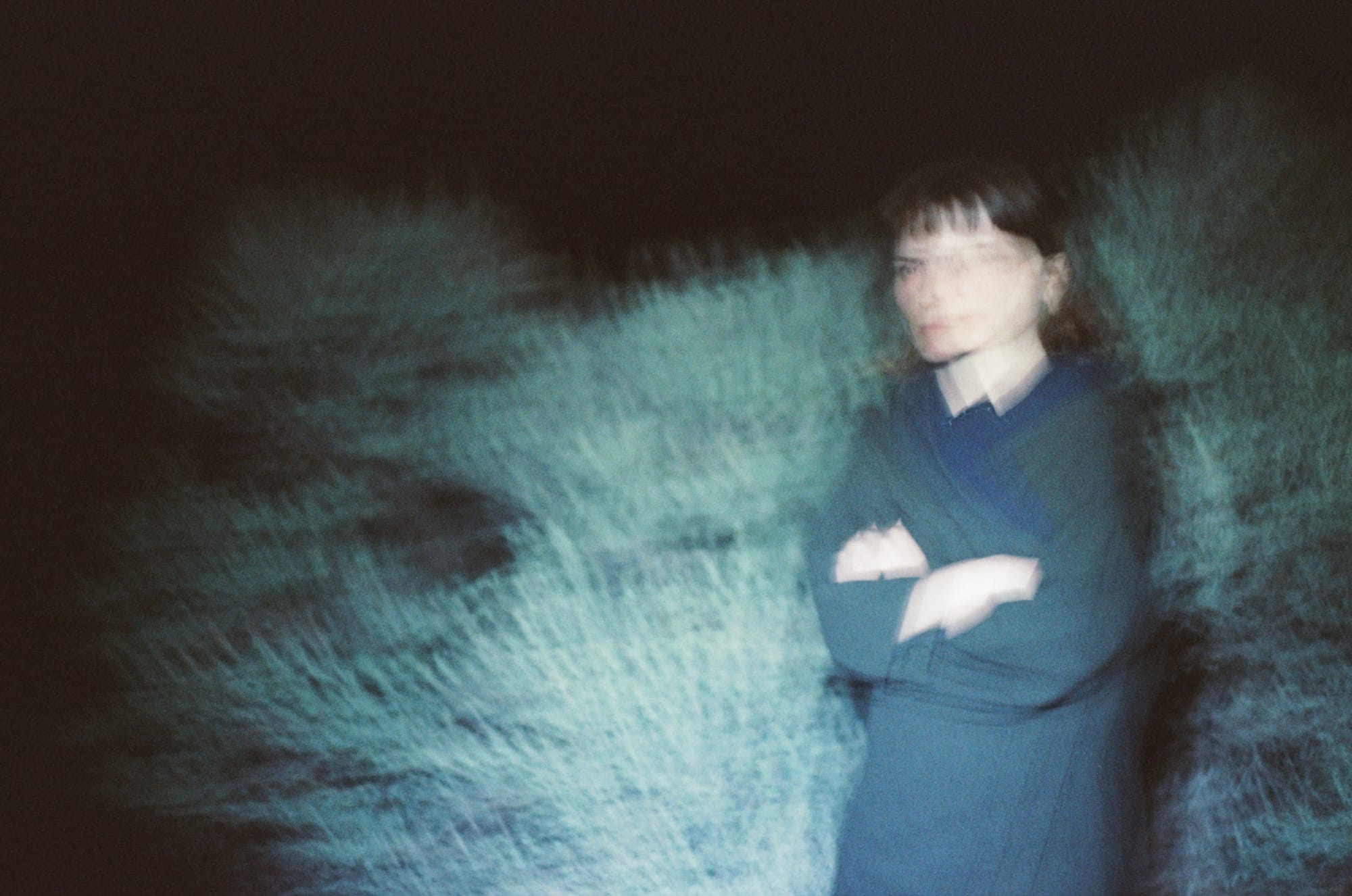
As we eat our way through hearty breakfast plates, I ask Horn about grad school and the eternal question as to whether an MFA is worth it for writers. “Writing is so solitary,” she says. “Having an actual writing community that you’re hanging out with and getting feedback from on an everyday basis is so special.” (Peer feedback remains important to Horn: She and fellow musician Helena Deland started their own long-distance songwriting club, dubbed the Dead Letter Office after the backdrop of Herman Melville’s “Bartleby, the Scrivener.”) One particularly brutal critique reshaped her perspective entirely. “A visiting writer told me my work was like background music in a restaurant,” she recalls. “Like something you don’t really listen to, it’s just there. It was extremely traumatizing, but it also changed my whole writing. I’m actually really grateful for that awful moment.”
Horn’s fiction demands time in a way her songs don’t. “My first drafts are terrible,” she says flatly. She spent more than seven years revising a single short story, one she originally included in her MFA applications and was told was so bad by one advisor, it likely kept her out of certain programs. She kept returning to it anyway. “I just couldn’t let it go,” she says. “I finally settled on the right perspective.” The story, titled “The Woman,” recently won the Halifax Ranch Prize and will be published in American Short Fiction this spring. The judges’ feedback was generous: “This emotionally insightful story about a woman who goes on a camping trip with her boyfriend and his daughter, who’s been mysteriously kicked out of summer camp, is clear-eyed and surprising and written with a spare, evocative, dreamlike precision that reminded me a bit of early Joy Williams,” wrote Dream State author Eric Puchner. Horn mainly seems relieved that she can put the story to rest: “I found out and it was like, finally, I can let this go.”
Before UVA, Horn spent a decade in Austin, where she witnessed the city’s shift from musician mecca and weirdo capital to a Texas hub for the tech oligarchy. “When I got there for college I was like, oh my God, this is the best thing that’s ever happened to me, this is my place,” she says. “It’s a totally different place now. A lot of interesting people have left.” It is still preferable to Horn’s hometown of 2,000 people: Glen Rose, located roughly 150 miles north of Austin and best known for its dinosaur tracks and massive outdoor Passion Play.
Glen Rose was strange in ways that seem fictional to Horn only in retrospect. She recalls one night after a marching band trip when the band stopped at Burger King just as the Passion Play was letting out. “So the whole band is in Burger King,” she says, “and in comes Jesus and Mary and Joseph.” When two teenagers started throwing chairs in the restaurant, “Jesus steps in to break them up. No lying. Jesus quiets the whole Burger King.”
Horn and I chat over empty coffee mugs for a while after paying the bill. Then we linger out in front of the diner, sharing cigarettes in the bleak afternoon light. I gathered that she was an occasional smoker from her new album’s closing track, “Untitled (Cig).” There, as the music comes to a glacial halt, Horn says it sounded great until she messed up. She then asks her bandmate Jade Guterman if they should pick it up from the flub, and Jade flips it on her like a therapist: “I don’t know, how do you feel about that?” There’s something heavy and mysterious about this ending. What is the source of this grief cloud hanging over the record, and Horn herself?
I bring up the striking line from her bio, about the sick mother passed around hospitals like an unsolved crime. Horn doesn’t shy away from it, but I instantly understand her fear as a writer. To promote her work by speaking frankly about her mother’s illness could, to the most cynical eye, come off as exploiting a bad situation, she says. But for this grief to show up abstractly in her music seems natural to me. It’s the sort of thing that leaves you with more questions than answers.
To put it in the broadest terms: Horn’s mom was in the hospital for a while, with sickness overtaking her body, and somehow recovered from it. Upon release, however, she experienced long-term psychosis that her doctors still cannot explain. This set off a string of mental-health misdiagnosis, not to mention a changed personality and a diminished quality of life. No one is entirely sure what to do about it.
Later, when I listen to Horn’s song “Love,” I hear it with new ears. “The love is always there/Like the moon in the middle of the day,” she whispers. Maybe she’s talking about her mom back in Texas, maybe she’s not, but now whenever I see the faint outline of the moon spying on the sun, I think about my own mom hundreds of miles away. And I smile.


