Liz Pelly on the Impact of Her Anti-Spotify Book ‘Mood Machine’ and Where We Go From Here
“The point is to encourage people to reject the idea that it’s a one-click solution.”
Since its publication a year ago, Liz Pelly’s Mood Machine: The Rise of Spotify and the Costs of the Perfect Playlist has become the go-to resource for anyone who cares about the meaning and worth of music in the streaming era. It’s a damning critique of the industry’s biggest streaming player, Spotify, that lays out how the company’s crass practices have served to turn music—our most visceral art form—into a background concern while devaluing it in a very literal sense, too. Through deep reporting and an unwavering ethical framework, Pelly took Spotify to task. As the book became a national bestseller, the streamer’s continued misdeeds were put under a microscope throughout 2025, leading to a steady drumbeat of negative press and many artists leaving the platform in disgust.
But when we meet at a Brooklyn cafe to discuss Mood Machine and its impact, Pelly doesn’t seem interested in dunking on Spotify yet again. Instead, she’s most excited to show me the guest book that she asked readers to write in during her globetrotting Mood Machine tour. The black notebook is filled with signatures, stickers, and notes of appreciation and DIY communion, some of which run several paragraphs long.
“When you write a book like this, you’re supposed to write for the most general audience imaginable—but for me, there’s a point where, if I’m trying to write for everyone, I end up writing for no one,” she tells me. “So I started imagining this moment after it was published, where I was having a book talk at a used record store, and thinking about who would come, and then writing for those people.”
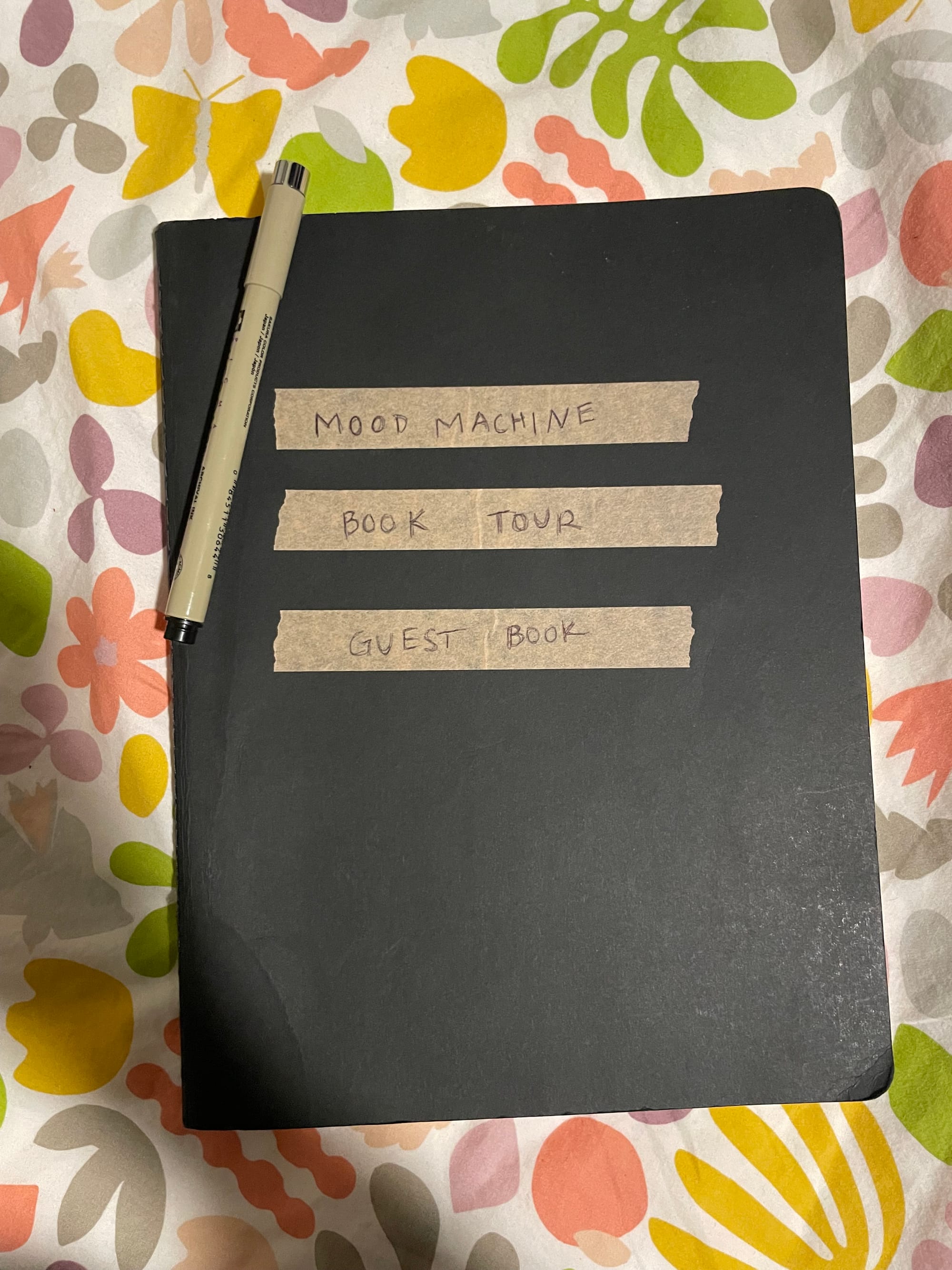
Flipping through the guest book, she recalls how that imagined scenario came to be at Joint Custody records in Washington, D.C. the same week the book came out, and how people lingered there to discuss issues raised by her writing. The same thing happened at a small bookstore in Lisbon. In Melbourne, Australia, she spoke with a group of graduate students studying the platformization of music, where everyone formed a circle with their chairs and tossed questions and ideas across the room. One of her most memorable stops was in Lawrence, Kansas and organized by an all-ages booking collective alongside a local bookstore and record store. “It was this really nice reminder that there’s cool music scenes in small towns everywhere,” she says.
More than anything, Pelly hopes her book continues to facilitate this kind of active conversation and interest in alternatives to the music industry’s current status quo. Because long after Spotify and its ilk are relegated to the tech scrapyard, Pelly will still have her principles. She’ll still be able to consult her guest book, and dream up new ways to further the camaraderie found within it.
Get access to everything we do at Hearing Things—including weekly album and song recommendations along with our ever-growing archive of interviews and reports—with a free 30-day trial!
At this point I’m sure a lot of people look to you as a guru of sorts, like you have all the solutions to the problems around streaming music—even though you point out in the book that it’s a collective issue rather than an individualistic one.
Liz Pelly: There’s one part in the book that I wish that people grasped onto a little bit more, which is: “Everyone wants an answer: What’s the ethical alternative to Spotify? The one I often provide is unfortunately unsatisfying to many, because it’s not simple. There is not one single answer, and it is certainly not merely to download Apple or Amazon Music or some other app that allows you to pay $10 a month for all the music in the world.”
There have been times where people are like, “I read your book and then I canceled Spotify and I got Apple Music!” That kind of misses a lot of the point that this book lands on, which is that the answer to so many of the issues that are raised isn’t just switching to a new streaming app. The point is to encourage people to be more active participants in local music communities and DIY cultural production, and to support independent music media, buy music directly from artists, and reject the idea that it’s a one-click solution.
There’s no “one size fits all” answer for the person who is like, What should I do? It requires more of a conversation: What’s your relationship with music? What are your interests? How much money and free time do you have? In a lot of ways, the fight for a world where music and culture are more accessible and democratized is connected to the fight for free time, because there’s so many people whose everyday lives are mostly spent on work and trying to survive. For a lot of people, being part of a local music scene is part of that survival, but there are some who might not feel like they could justify the time or financial investment that it might seem like is necessary to be part of a music scene.
It’s also important to remember that what it means to participate in music culture doesn’t start and end with recorded music. There’s playing music, doing radio shows, hosting shows at your house, building communal libraries. These are all ways that music can be part of your life that don’t involve building a collection.
In the book you mention how you worked at the New York DIY space Silent Barn for years in the 2010s. Do you miss that part of being in an active music scene?
I’m a really big champion of the idea that anyone who is able to should try to have a house show in their home once a year. The last one that I hosted myself was in December of 2024 and it was a fundraiser for Zohran Mamdani. I organized it with two of my friends, and it’s a really special show in my memory.
What do you remember about that show?
I have a really small apartment, and there were around 30 people there that we invited over email. It was the day the campaign’s field operation had launched, and Zohran FaceTimed in to talk to us. He made some connections between the main policy pillars of the campaign and the interests of musicians and artists. He also said the sentence, “C-list rappers of the world unite, we have nothing to lose but our streams.”
I’m curious about the demographics of the people who have been coming to see your book events and messaging you on social media. Because one of my pet peeves is how whenever I come across a TikTok video of an artist playing their own song, one of the first comments is always, “You need to put this on Spotify.” Like the music doesn’t properly exist if it’s not on this one streaming service. It makes me worried about the generation that grew up with streaming as the main way to listen to music.
I went to speak to a lot of colleges, and this is a subject where undergraduates and professors share a Venn diagram of interest. I was glad this book can provide a tool for instructors who are trying to reach Gen Z students who have been raised on streaming, and to open up new ways of thinking about technology and music.
But the kinds of people who have responded to the book really varies, from record collectors, to people in bands, to anti-industry punks, to people running independent record labels, to people with pop-career aspirations. Tons of people who have worked at streaming companies, labels, and distribution companies have contacted me after reading the book to say, “This is what we’ve all been talking about for 15 years. Thanks for making something that we can point to when we’re trying to communicate something big to someone who isn’t familiar with this conversation.” I’m just glad that it’s useful.
One detail in the book that was a little unexpected was how Spotify had an internal “ethics” Slack channel, where they would discuss big ideas and some of the negative press being written about the company. Were you surprised to see how that discussion was taking place?
I was surprised. And over the past five years I have definitely learned that there are a lot of people who end up working at music-tech companies who are grappling with these bigger issues. In some ways, it encouraged me to be a little bit more understanding of that perspective. There are people who work at tech companies because, for a certain skill set, it’s one of the only jobs that you could have, and their personal beliefs are beyond the scope of what they do. A lot of the economy revolves around this type of work. But also you want to hold people accountable for their contributions to building this system that has been really harmful for music and culture; this ideology has consequences in people’s lives.
There’s a chapter in the book about generative AI and music, but I feel like so much has happened in that space across the last year that you could probably write a whole other book about that issue alone now. There’s one line in the AI chapter that jumped out at me when I was rereading it for this interview: “Fake mood music streamed by fake listeners: Is that where the arc of recorded music industry ‘innovation’ eventually leads?” Based on everything that’s happened this year, it seems like the answer to that question is, sadly, yes. What do you think about how fast AI is advancing?
I’m surprised by how fast so many of the deals are coming into place, like how Spotify recently announced a partnership with major labels to work on in-house gen AI tools, and the deals being struck with [AI music platform] Suno. There’s so many parallels with the dawn of streaming—major labels inking deals with large tech platforms that would go on to impact the entire music marketplace.
I would love to know more about the thinking of the big indie label groups, like Merlin, who are also signing these deals with AI companies, because right now, the benefit for artists is really unclear. Even for business people, how could you possibly see the opportunities outweighing the issues that this will create for the value of music in the world? Even if you have an AI model that is licensed, where there is some compensation going back to rights holders and to artists, those deals are still contributing to the normalization of this prompt-based relationship with music that ultimately serves to devalue how people think about artists and the role of music in their lives. It just seems pretty short-sighted.
I was reading about Warner’s recent deal with Suno, which said that the label’s artists will be able to decide whether they want their music and their voice to be used in AI-generated songs. I think that could become a new litmus test: On one hand, it seems like an extremely lame thing for an artist to opt into. But on the other hand, they could make some money, and there might come a time in the future when an artist’s influence and relevance rests on whether their music is available to a program like Suno.
So much of the power of major labels is rooted in their ability to protect this idea that musical genius is this rare and scarce thing that only they have ownership over. I think AI tools should be reined in, but in some ways, reining them in around the idea that they can just be used to create remixes and interpretations of work by pop stars serves to limit people’s imagination of what music and creativity can be.
As a conscientious music listener, one thing I’ve been thinking about a lot is Bandcamp. A couple of years ago, it was sold to the music-licensing company Songtradr, which proceeded to lay off half the staff, including many unionized workers. But at the same time, it’s hard to compete with the catalog they’ve amassed over the years, and they’re definitely espousing better values than a company like Spotify. What’s your current take on the role of Bandcamp in the music landscape?
Bandcamp has a much stronger hold on my daily listening than any streaming service does. But the layoffs, union busting, and the sales of the company to multiple different corporate media entities make it really hard for me to ever hold it in the same regard that I once did. It was previously a lot easier to just point to it as the obvious streaming alternative, with the acknowledgement that allowing one tech company to have such a hold on all of your music listening—or all of your business as a label or artist—is really unsustainable. It always felt risky for the independent music world to throw all of its eggs in this one basket. But I find it a lot easier to be understanding of artists or independent labels who are like, Well, this is the best that we have. And I still turn to it as a way to buy a lot of music.
I’m also really interested in the alternatives that have popped up. I have Nina on my phone, and I try to remember to use it as much as I can. I’m really interested in the perspectives of independent artists and record labels, so as these alternative platforms like Subvert, Tone.Audio, and Mirlo start to roll out more seriously, I want to see which ones independent artists and labels like and find useful. And I don’t think there has to be just one winner. I could definitely see a reality where there’s different scenes that emerge around all of these digital tools. To be honest, it would be way healthier to have a digital independent music landscape where there’s lots of different communities using the tools that work best for them.
When I think about alternatives to streaming, there’s so much more that we could be doing with the idea of a digital music library. There was a book event I did at a DIY venue in Providence that was co-hosted by my friend Mike Sugarman, who runs this thing called Freq, which is a digital tool that offers a music discovery system that draws from college radio. He contacted me a week before the event and said he was thinking about putting a call online for independent musicians in Providence who might want to submit their tracks to a local music server that could live at this venue, so that when people are there they could log into a browser-based streaming service and access all of this local music that artists have submitted. So at that event, there was a computer setup and server that was running, and instructions posted about how people could access it. It was a really inspiring and creative idea.
The thing that excites me the most is the idea of a landscape of local public libraries and public institutions in general being more involved in supporting music. If we could easily take a record out of the library digitally, it would be such a net good for culture. Maybe that is an area that’s worth giving some organizing energy to, even more so than trying to reform these streaming companies.
How have you dealt with becoming something of a public intellectual in this field? You don’t strike me as someone who’s necessarily craving the spotlight.
There’s this idea that’s baked into the book and really central to my way of thinking about culture: Popularity does not equate to value. It’s been interesting to keep that in mind while going around and talking about a book that has achieved some degree of popularity, trying to figure out different ways of considering the impact and value of a project like this outside of whether or not it’s popular. And also remembering that there are other people who have done really good work about this subject for a long time and trying to highlight them. Even in the book, I tried to cite the work that academics and journalists have done and point people in the direction of other books they could read if they want to do more research, like Streaming Music, Streaming Capital, Computing Taste, Spotify Teardown, and The Spotify Play. They’re all insightful and look at this story from different angles.
I imagine that taking on a project like this can take its toll as far as uncovering and synthesizing all this information about the music industry that is mostly very dire. How has the experience of writing this book and talking about it affected you as a listener and a person?
That’s definitely true about it taking a toll. In the book’s conclusion, I write about how people in power maintain their position not just by controlling the market but also by convincing us that there are no alternatives. So to me, one of the real powers of DIY cultural production is that when you’re involved with it, it teaches you again and again that alternatives are possible in a world that really doesn’t want you to believe that that’s true. Knowing that makes this sort of work feel a lot less depressing.
