


AI Album Covers Have No Place in Hip-Hop
A visual artist who built his career on creating covers for independent rap records laments how AI is bastardizing his life’s work.

Rap album covers are my life. For the past few years, I’ve been able to pay for every meal I ate, every tank of gas, and every rent check with money made from hand-drawing and painting visuals for underground rap records. My methods are thorough: I listen to the full album, take pages of notes, and look at every cover in the artist’s discography to see where they’ve been and where I’d like to see them go. Then I present multiple concepts, sketch, outline, color, shade, and detail. There are usually multiple rounds of editing before I digitally scan my work, clean it up in Photoshop, and format it for physical copies, merch, and posters. Often I meet with the artists in their studios or homes. Sometimes they sleep on my couch.
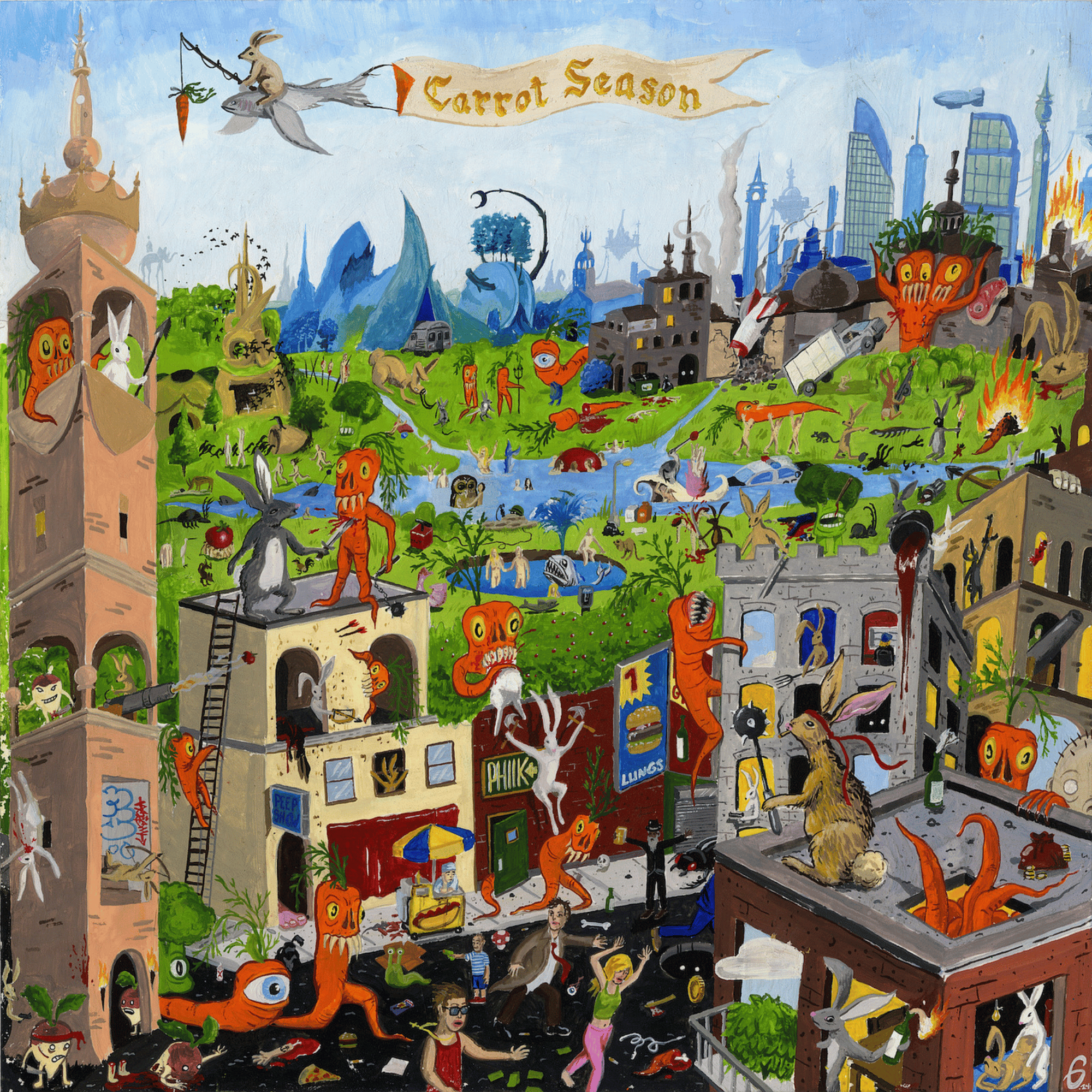
It is a long and personal process that has pushed my pen a great distance, connected me to real community, and led me to create some of my proudest work. For the cover of Lungs and Phiik’s Carrot Season, the New York duo threw me a stack of references ranging from Hieronymus Bosch, medieval manuscripts, and the documentary Gods of Times Square. I spent a month distilling all this imagery, along with visual references to bars from the album, and painting it at scale with a brush as thin as a nose hair.
The process for Let Me Out, by the New Jersey rapper Fatboi Sharif and producer Driveby, was much more open ended, with Sharif asking me to riff on a hellish version of “American Gothic”: The cover depicts a demon police officer restrained by a Black dominatrix posing for a family photo with a child. This is the kind of unrestrained, creatively rewarding work I’ve pursued my entire career.
But now, generative AI is here to offer an alternative to all of this sweat, beauty, and purpose. Rather than spending late nights at my desk figuring out how to best present music made by my incredibly talented friends to the world, our tech dystopia is pushing me to scowl at my phone and wonder, Does the cover for this new record by indie-rap legends the Alchemist and Oh No look like shit on purpose or by accident?
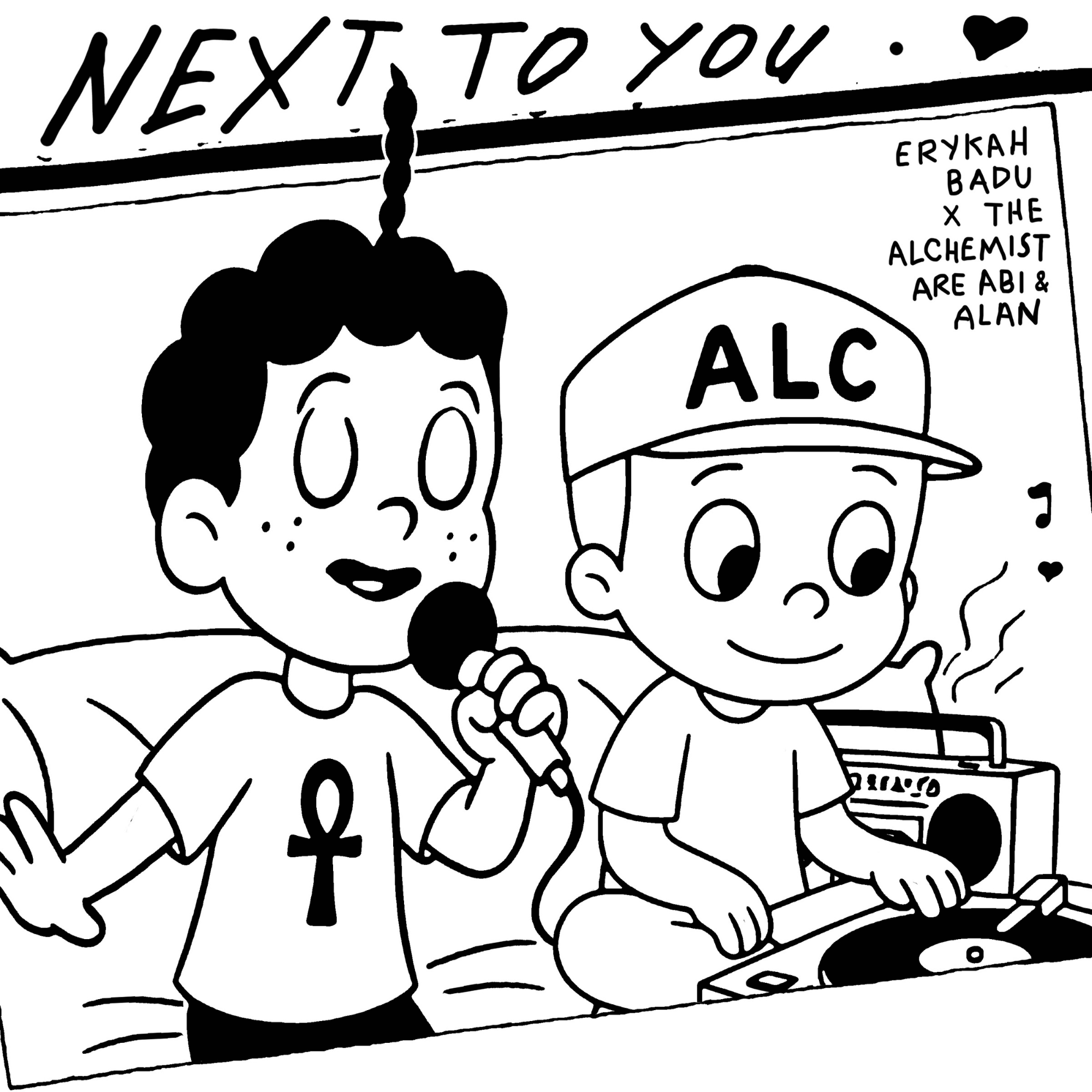
The Alchemist, who’s been carrying the torch for underground rap for three decades, is an honorable man. He just seems to be going out of his way to be the poster boy for AI in our lane of hip-hop, and provides a case study of a growing problem. How did we get here? Well, the Alchemist had previously taken flak for the apparent use of generative AI for the cover art of his June EP Liquid Form as well as the visuals for a collaboration with Erykah Badu. In the case of the Badu project, the disappointment was widespread and resounding. When the cover and animated visualizer for their song “Next to You” was posted last year, fans spotted AI’s fingerprints immediately: Animated music notes crumbled into senseless shapes, fingers and spliffs fused into each other. The kind of mistakes Walt Disney used to send people to the firing squad for. People vowed not to listen to the project at all strictly because of this artwork. At the time, Alchemist took to Twitter and defended his creative decisions, saying, “I listen to music with my eyes closed,” and, “A cellphone is AI think about that.” Released in August, the full Badu/Alchemist album, Before the World Blows, featured a photograph of the pair on its cover. (The Alchemist did not respond to a request for comment.)

Corus is a social app for sharing and discovering music. Post your favorite songs and match with people that share your taste. Follow @hearingthings on the app too!
The Alchemist’s fans were so sorely disappointed by these album covers because he is an artist who bridged generations with his uncompromising creativity. I write this as someone whose approach to music and design was changed by his work. When many of his peers stuck to a formula, or stopped listening to younger rappers, Uncle Al kept his ears open, took risks, and fought uphill. He struck out independently when easier checks must have been on the table. He made thorough, detailed music under the banner of a revolutionary genre that marched us forward, therefore his fans hold him to a higher standard than most.
Artists borrow, flip, and steal styles all the time. And the Alchemist’s production is largely defined by the way he artfully samples music made by others; the AI-assisted “Next to You” visuals riff on the iconic cover of Sonic Youth’s 1990 album Goo, drawn by the artist Raymond Pettibon—who, by the way, is alive and working. I actually paid tribute to Pettibon’s cover of Family Man by Black Flag for the cover of Q No Rap Name’s 2025 album Living Room. Q and I were both punk rock kids who grew up looking at the Black Flag covers. I went to his house and drew him and the objects in his studio in real time. Pettibon’s style is in my artistic DNA, and it meant a great deal to pay homage to his work while tweaking it for a hip-hop album. Whatever robocop was used to make the “Next to You” single cover couldn’t even render an eighth note properly.
When artists use generative AI, progress and experimentation are inherently absent from the process. Working organically, human artists insert their own selves. How they felt that day. Strange childhood sense-memories. The way only their hands can touch their medium. In this transference is the ancient and ineffable blood-pact of creation. An AI program can only ever replicate and combine that which it has already seen and, in the context of art, has already been expressed by human hands. AI can never push creativity forward because it has never broken a bone, grieved, or been loved. It has nothing to say that hasn’t been said.
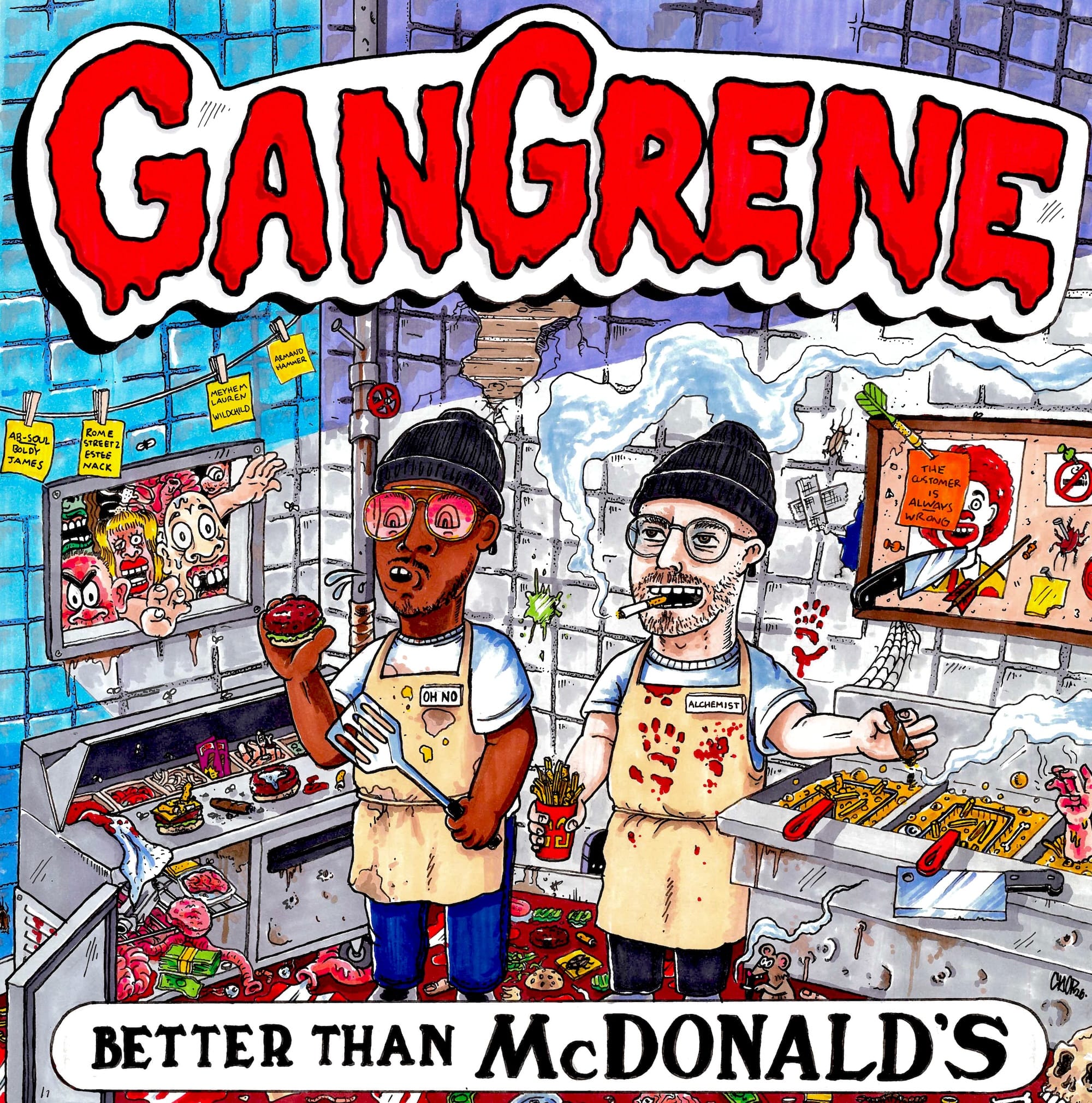
All of this flashed through my mind while staring at the cover of this summer’s Better Than McDonald’s by Gangrene, aka the Alchemist and Oh No. On first impression, the cover is ugly, and it communicates nothing. People know when they are being short-changed, and credit is due to Alchemist’s fanbase for maintaining their standards. Again there was an immediate gut reaction to telltale signs of AI: regurgitation of an existing style, rendering slightly to the left of exact, irrational corner-rounding, unnatural numbers of fingers on hands, non-objects, that sickly Backrooms overtone. Twitter lit up with people criticizing the work, including yours truly. Then, Alchemist posted a close-up of a clearly handpainted version of the cover on Instagram, crediting it to someone named Alice Xiu. But when you look up Alice Xiu, you will find no artist by that name.
Intriguingly, the first thing you do find is a young Australia-based painter with a similar name: Alice Xu. Even though Xu has no apparent background in cartooning, nor any discernible connection to hip-hop, could she be the artist in question? Why would you hire a realist painter to draw a cartoon? You probably wouldn’t. You might, however, reach out to an unknown but competent realist painter if you needed an exact copy of something—say, an AI-prompt cartoon—skillfully rendered by someone whose reputation isn’t at stake. (Alice Xu did not respond to a request for comment.) As strange and petty as it sounds, I would bet an arm and a leg that AI was used to generate the Gangrene album cover, which was then copied by a human painter to provide “proof of authenticity” via Instagram.
In the same post, Alchemist claimed the cover was a reference to ’80s Mad magazine. The image isn’t just a general reference, though. It’s squarely in the style of Mad cartoonist Tom Bunk, who, like Raymond Pettibon, is alive and working. The ethically sourced, free-range vegan version of this would be to pay Bunk to draw in his own style, which Alchemist has the resources to do. Or, at least, to pay a human who has reverence for the reference and the artists involved to create a handmade piece. In that spirit, I went ahead and drew my own version of the Gangrene cover for this story.
One of the biggest crimes of AI and tech companies is that they have laid claim to the whole world without asking. There is no meaningful regulation on what data can and cannot be fed into a program as the raw material for image generation, and little to no protection for artists such as myself who have old-world ideas about copyright, intellectual property, and biters, and would opt out of our art being used as source material for these programs instantly if given the opportunity.
But Chop!, the people cry. Don’t you make beats too? Isn’t referencing artists using generative AI the same thing as sampling other people’s music? Well, would it be interesting to hear the midpoint average of all Italian film scores from the ’70s? Not really. That’s mid, by nature. But would it be interesting to hear a kid from New York City in the ’90s interpret Italian film scores from the ’70s through the lens of his own life experience? You’re goddamn right. A computer can never produce the latter without the raw data of the RZA doing it first. I have no issue with flips, homage, satire, interpolation, or creative reuse, but my personal code has hard and fast rules about biters.
The point of Alchemist’s bait-and-switch seemed to be to say to his fans, See? It’s not AI, and it wouldn’t matter if it were. Shut up and eat your McDonald’s. This move speaks to him not understanding the full scope of his fans’ objection. It isn’t strictly about sloppy aesthetics or artistic credit. The main problems with AI are environmental, political, and economic.
No AI booster has any answer for the technology’s environmental impact. According to a UN study, AI-related water consumption could equal the annual needs of 1.3 billion people by the end of this decade. A Cornell University study found that the data centers involved could release up to 44 million metric tons of carbon dioxide into the atmosphere annually by 2030, the equivalent of adding 10 million cars to the world. All for something that didn’t exist a decade ago, came about well beyond the tipping point of environmental reform in regard to greenhouse gases, and without much opportunity for informed public dissent. We as Americans and so-called “first-world citizens” are complicit in evil perpetrated somewhere every day by nature of our participation in and funding of our governments and industries. But the Alchemist has a button that makes posters for low-rent strip mall hookah lounges and makes the world burn a little hotter every time he presses it. And he presses it. And presses it. And presses it.
As far as we know, the Alchemist’s use of AI has been limited to cover art, but the technology is encroaching into the music industry at large, from generative soul samples to completely synthetic songs, albums, artists, and record labels. Recently, Fenix Flexin inspired a similar debate with his ’80s-flavored hit “Rubberz”: Is it AI or not, and does that matter if the song is getting play? Like the Alchemist, Fenix willingly muddled the truth when asked how exactly AI was used in the creative process, and the back-and-forth seems to have overshadowed the music. In terms of creative merit, “Rubberz” skates on the novelty factor of hearing a contemporary West Coast trap rapper try out a Morrissey impression rather than contributing to the genre in any way. Tyga repeated a similar gimmick for the instrumental work on his new record $tarface, using what he believes to be cutting-edge technology and the crutch of nostalgia to craft an album that is just slightly worse than the rest of his catalog.
Timbaland famously co-founded a record label for entirely AI-generated artists last year. He is under direct contract with the generative music creation company Suno, which is partnered with Microsoft, and gets paid to use and push their product. There are entirely AI-generated country and rock acts like Breaking Rust that have topped Billboard charts. No studio budgets, no creative disagreements, no personality clash—no personality, period. Every AI artist is in an automatic 360 deal, in perpetuity, created solely to be exploited. And for successful artists to employ generative AI is to outright burn the ladder they themselves used to climb to where they are. In all of these cases, the music can only ever be derivative due to the inherently copycat process of machine learning.

Gain access to everything we do at Hearing Things—including podcasts, album reviews, and more—by signing up for a free 30-day trial.
Other than AI’s speed and price point compared to human artists, the primary defense I have seen across the board from boosters is that the technology is here, and they don’t want to be left behind. This rhetoric of inevitability is not a hard truth, but rather the party line of the tech companies themselves. To them, our acceptance of their dominance in the future is worth trillions of dollars, and control of the most invasive transnational surveillance apparatus in human history. As is always the case, any creative, cultural, or consumer-level debate around generative AI is all smokescreen obscuring purely economic motivations, both on behalf of artists and the companies themselves. The divide of power is now between the people who build and own the technology, and the people who use it.
The social conditions proposed by the companies profiting from AI are beyond Orwell’s bleakest thoughts: constant surveillance; mass behavior modification via social media; extreme wealth concentration pushing most humans into a permanent underclass; fully-automated social credit and criminal justice systems; art and culture as individually tube-fed corporate consumption rather than communal connection. (And that’s if humanity can even survive the next few years of unregulated expansion.) These are not speculations or conspiracies, they are the openly stated predictions and even goals of the tech CEOs behind OpenAI, Google, and Palantir, the men behind the curtain of the proposed next generation of “artists.” This is the real scale of the problem and what is truly at stake.
The grassroots Black radical origins of hip-hop should have every artist in the genre calling for all these motherfuckers’ heads on pikes. Instead, celebrated rappers and producers are selling out the culture in exchange for artwork usually reserved for the world’s shittiest hot chicken restaurants. Timbaland, Alchemist, and those in their position are pawns whose function is to make the dystopian products and practices of tech companies palatable. If you can get people to accept the computer as a rapper, you are one step closer to getting them to accept it as judge, jury, and executioner.
Google and OpenAI, the two biggest names in town when it comes to AI image generation, have extensive contracts within the criminal justice, intelligence, and defense industries. Their tech is being used in the ongoing genocide in Palestine to comb through data and select bombing targets. It is also being used by police departments to identify, profile, and locate American citizens by collating social media posts, cell phone data, and surveillance camera footage from networks like Ring and Flock, both for criminal cases and to deter and harass political protesters opposing ICE and the Trump administration. To put it simply, AI is the feds. Where hip-hop artists could be employing human beings, they are instead throwing layups to carrion vultures.
This isn’t the world I wanted. Every day I have to squint a little harder at my phone to figure out if I’m dealing with real photos, real videos, real people, real art. Without being hardline about the use of AI, asking questions, and halting “progress,” my generation may be the last to whom the difference between man-made and computer-generated means anything. We came from a time where art was entirely created by people who lived and suffered like us, with techniques passed down in some cases since humans had time to dream of anything at all beyond mere survival. Art was intended to share ideas, feelings, stories and hopefully guide us into a just and moral future. This vital historical thread is being severed, and the children born today may mainly experience art as hollow and constant stimulation from corporations, and never wonder who made that picture, how, and why. Just give me something—anything, right now—to distract me from the flames.
AI art is not cheap. The cost is just passed down to those who have been deemed expendable. On a grand scale it is a betrayal of humanity. But the issue with this Better Than McDonald’s artwork specifically can really start and end here: The sole purpose of an album cover is to reflect the music on the record, and make people curious to listen to it. What Gangrene seemed to do was make their cover concept a petty jab at their own fans, and a celebration of greed and swagger-jacking brought to you by billionaires and the police. The hip-hop I grew up on taught me to tear that kind of shit to pieces. If the people behind the music can’t be bothered to invest more than a few seconds into their album covers, how dare they expect us to spend our time listening to it?


