


The Afterlives of Okayplayer
The story of a message board that changed hip-hop forever

Hearing Things is partnering with the grantmaking and learning initiative Critical Minded to publish the following adapted selection from Liner Notes: A Critic’s Notebook, a new collection exploring the changing landscape of music criticism through essays, conversations, and reporting from critics of color. The complete issue, accompanying the report Beautiful Struggles: Critics of Color and the Pop Music Landscape, and companion podcast are available at Critical Minded.
A few years ago, I started hearing from my communication and music students at NYU, Seton Hall, and Borough of Manhattan Community College about the excitement of discussing new albums on Twitch, in group chats, and in password-protected Discords. The heated public debates on message boards and Twitter have largely migrated toward these sorts of private online spaces—a shift with both benefits and downsides. You can forge tighter bonds, but groupthink can also create echo chambers. Back in the day, informed heads would check you for your bad taste, then educate you.
I recognize that, for Gen Z, the internet is where hip-hop has always lived, and my students are just trying to carve out their space in hip-hop fandom. I relate to this desire. For decades, the music lived in the imagined “streets,” but that all began to change around 1999, when my fellow music obsessives and I helped to establish one of the first online homes for hip-hop: a message board and community known as Okayplayer.
Decades before social media and the phrase “online music community” were studied in academia, Okayplayer was a pivotal early outpost where hip-hop fans from all over the world could commiserate, debate, build bonds, share music they liked and made, and interact with their favorite artists. Co-founded by writer Angela Nissel and Ahmir “Questlove” Thompson, it transformed from a standard fan site for the Roots into a tastemaking hub for left-of-center hip-hop and a Black digital homeplace—a forebear of Tumblr, Black Twitter, Soundcloud, and Reddit. Okayplayer also functioned as a talent incubator, where a national pool of music nerds helped artists refine and elevate their games, ultimately leading to new waves of hip-hop music that endure to this day. And along the way, it changed hip-hop fandom as we know it.
In 1999, I was a senior at a rural North Carolina high school who happened to own an Ecko T-shirt with “okayplayer.com” printed on it. In my computer tech class, I typed in the web address and found this black-and-white text world of people with cool aliases talking about Black Thought’s best verses and funny Rap City episodes, with Questlove actually responding to questions from regular users. Me and most of my friends were Wu and Roc-A-Fella fans at the time, but this was a space where I could nerd out and learn from strangers and real artists about the underground and music coming out of my own Southern region, not just the major-label East Coast hip-hop that was popular at school.
Taste is a means of experiencing the world. The word is primarily sensory, but even in its origin, it confers critical evaluation: “tasten,” its Middle English root, means to touch, taste, or test—and in this space, we could test out some of everything. We joke about social media’s age range today, but OKP had teenagers like me, thirtysomethings like Questlove, fresh-out-of-college folk like Nissel and even older music heads of all genres communing in the same space. This diversity allowed for taste expansion beyond hip-hop: Users would post BB King and Lou Reed memorial posts with a treasure trove of music and context, while denizens of a subforum called The Lesson would help popularize the term “yacht rock” (and correct you on its right usage if you were confused). Among other things, OKP was a place to learn about music from people who knew more about it than you. My degree may be in communication, but I was trained in musicology by OKP.
On this message board where we traded album recommendations and life stories, for the first time, the hip-hop fan was no longer an invisible, imagined audience or the occasional radio call-in critic. The internet gave the fan a voice. Before it all metastasized into Stan armies and parasocial psychosis, we were unknowingly creating a grammar of online music fandom—not just fawning over our faves, but critiquing, interrogating, and challenging them. The barrier between artist and audience was coming down.
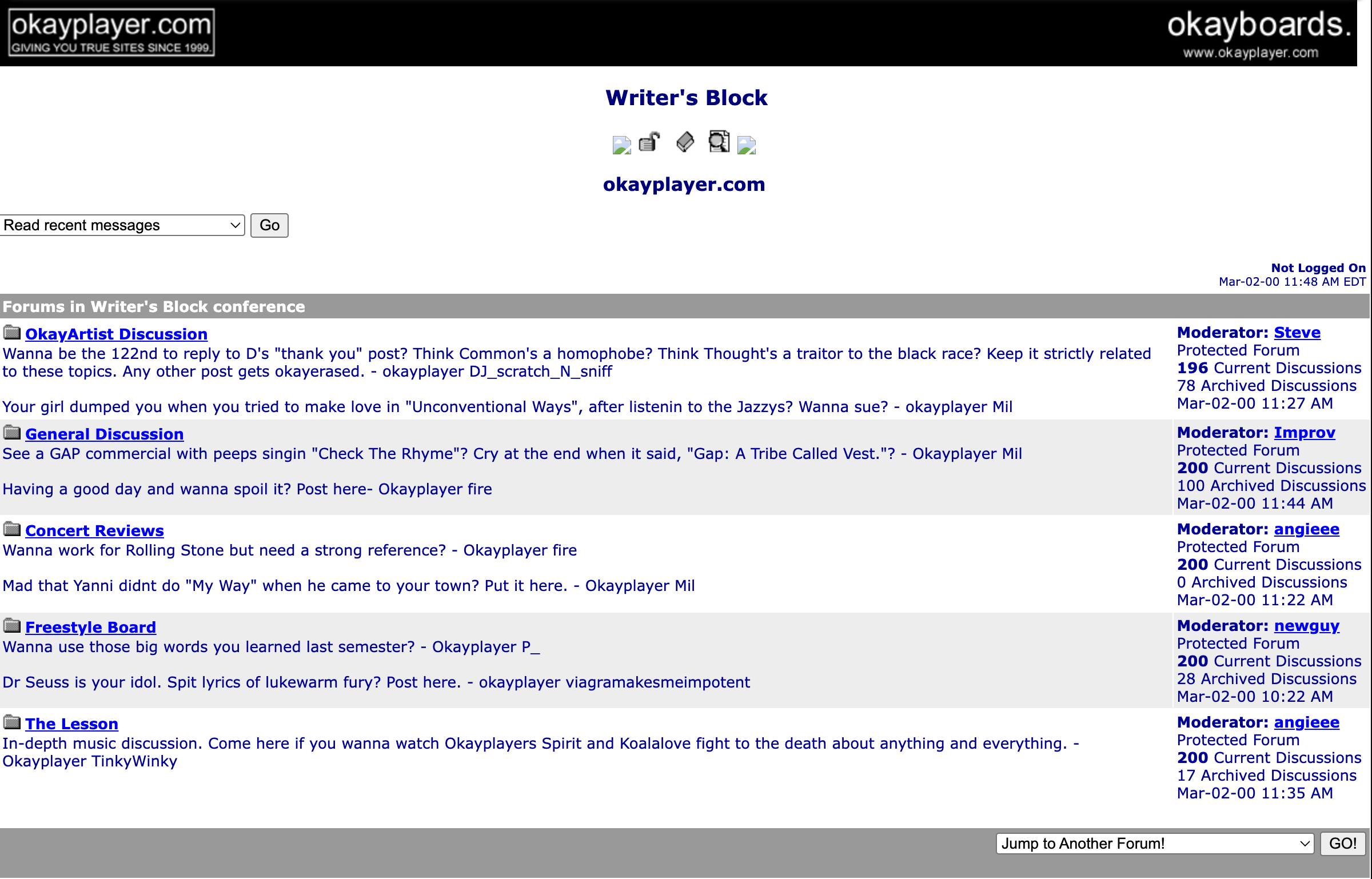
On social media today, you can see people disparaging the “armchair A&Rs”: Fans who give unsolicited advice, acting as if they work in the industry. If you check my X bio, you will see “armchair A&R.” At OKP, we embraced this persona, recognizing our agency and letting artists know what we really wanted. As comedian, podcaster, and former OKP moderator Desus Nice once noted fondly, we had artists like Jill Scott and Talib Kweli mad enough to address OKP’s armchair A&Rs in song. Old heads like myself can have rap-fan amnesia, claiming that the current disinhibition in rap fans online is a sign of their dysfunctionality. In actuality, it was passed down from us.
But often, underneath the occasional vitriol on the OKP message boards lived solid constructive criticism that artists appreciated. A moderator named fire100 once told me many artists “from Prince on down” would lurk with obscure names to get blunt and honest feedback in the same way musicians search their names on Twitter today. As OKP founding member Shawn Gee told Complex in 2013, “Before that, there was always a third party between the fans and the artist. Sometimes for the good, sometimes for the bad.” I co-sign user mistak5’s sentiment, shared in 2019: “The snark was part of what made [OKP] so great but we definitely took it too far many times.”
Indeed, OKP was a primordial space for music snark and clapbacks that live on in Black digital culture today. We often went too far, but we were figuring out our identity and voice, just like today’s youth. While there were internet trolls, most people didn’t critique music for clout, because fandom couldn’t generate sponsorship deals or anything tangible besides props back then. They were just sharing genuine opinions and beliefs in a democratic space where criticism could be a form of support.
When I consider the afterlife of OKP, the sincerity is what I always return to. I see traces of the site’s snark everywhere, but the community aspect that helped contextualize that snark is often missing. Sharing knowledge and taste—and supporting each other—is what really made OKP special, and it’s also something I worry my students don’t have access to in today’s climate.
OKP was a social network predicated on what fandom expert Nancy Baym denotes as “the five hallmarks of social music communities”: a sense of space, shared practice, shared resources and support, shared identities, and interpersonal relationships. It felt like a home—not just a public forum, but a productive dwelling space for identity and taste. And for Black folk in particular, this digital hush harbor allowed us to freely express ourselves, share our identities, and commiserate with others—without any interference from outside sources—before a digital identity could be attached to you. OKP embodied what we call in social network studies “structural equivalence,” where there’s no hierarchy, and no demarcated preference. Any type of fan could be heard.
Nissel, the creator of the message boards, told me once that as young Black people, “We built this community because we needed it!” And as DJ, artist, and podcaster Donwill argued, “The Roots found fans, but we found each other, and having the space to be honest and seeing other people have honest conversations inspired you to feel you could be real.” You could discuss your college life or your breakups alongside the music. This is why I don’t fully embrace the argument that OKP was the original Black Twitter—because it was more than that. It was a social network functioning as a homeplace. But its influence is undeniable: The rhetorical innovation of Black signifying through memes and jokes was present in OKP’s early days, long before social media.
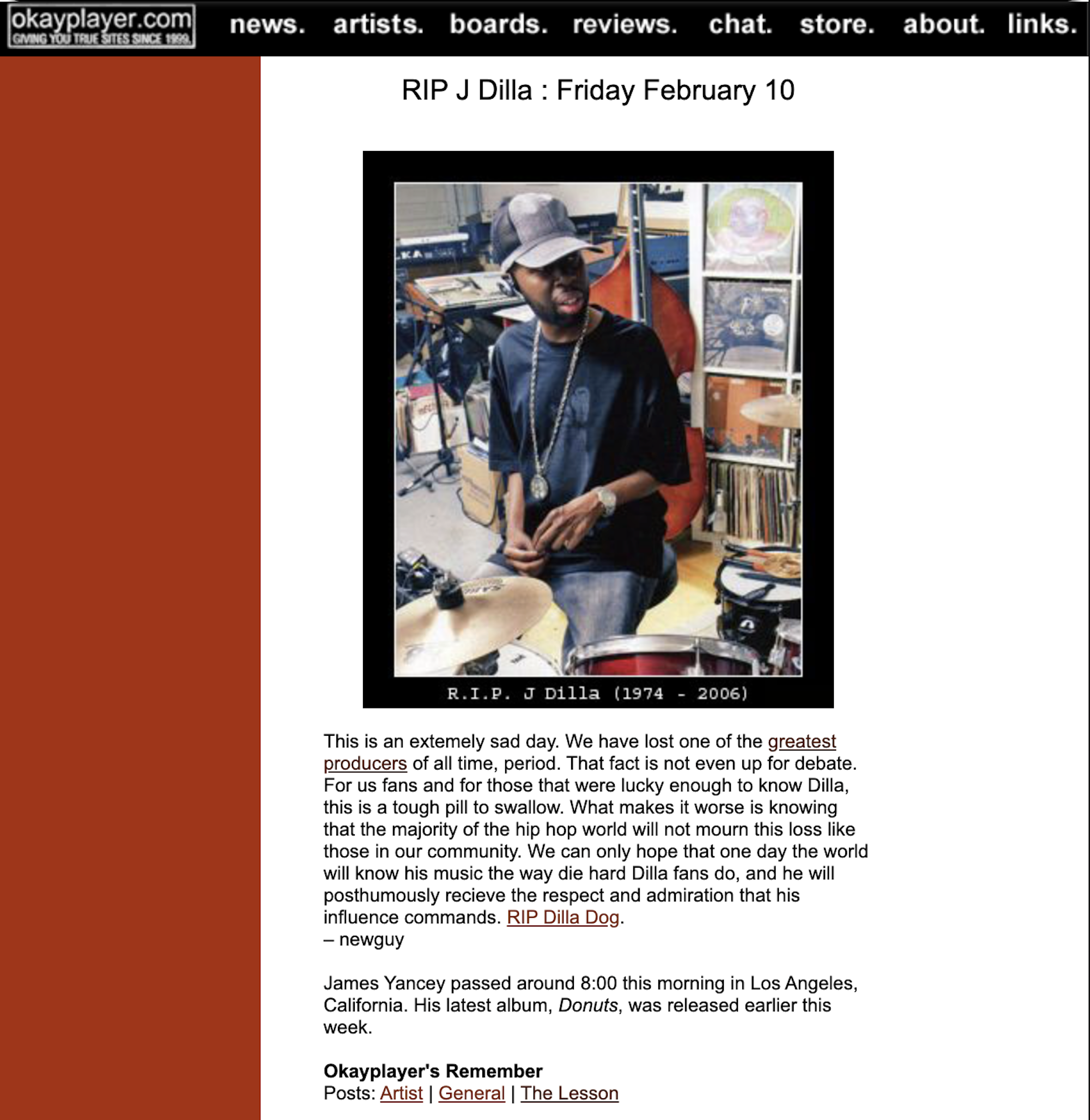
In music-fandom studies, there’s much discussion about relational labor, which is often how users make fan pages, merch, and beyond for clout and to garner attention from the artists. We had a solid dose of that on OKP, but the real relational labor was stuff we made for ourselves. Fans were making OKP TV and filming vlogs about artists that we championed on the site like JDavey or Janelle Monáe. They were shooting rare performances of the Roots and Jimmy Fallon in 2009. Fans even made WTF: An Okaymentuary, a 30-minute doc on the history of the OKP message boards. Similar to the Discord servers my students frequent, we created OKP Music Club to share music directly and talk offline. Users Deephunk and DJ Tara took their love for J Dilla and made Donuts Are Forever, currently in its 20th year, as a global event celebrating the life of Dilla, a patron saint of the site.
North Carolina trio Little Brother was one of the first hip-hop groups whose fans lived online. They framed themselves as students of hip-hop’s golden age, retaining its lessons as they pushed the culture forward. They rapped about the things we talked about on the boards: dating, jobs, and wanting to do something creative. It’s no wonder they spoke the language of Okayplayer: They themselves were active members. For them, OKP functioned as a musical sounding board and an online street team, spreading the word from the internet to the industry.
As a North Carolina native, I was just 45 minutes away from Little Brother and their Justus League crew. I knew firsthand that there was no street buzz for the group back then, outside of their support at the beloved (and tiny) Carrboro venue Cat’s Cradle. But online—anticipating the later tactics of Stan armies and clipping teams—we were Little Brother missionaries, spreading the gospel about online friends becoming underground hip-hop icons. We shared grainy tour videos, bought merch, and posted magazine-interview scans. Hip-hop icons like Pete Rock and De La Soul were soon up on Little Brother; it was only a matter of time before major labels came calling. They were featured in XXL and The Source and gave Red Bull lectures. The group’s producer, 9th Wonder, started working with Jigga and Beyoncé.
According to Little Brother’s Phonte, the boards were also important in terms of creative feedback. “I remember those early days of making records and putting them online, and it was like, ‘Yo, if this ain’t right, we’re gonna hear about it. The Player gon’ tell us,’” the MC once said in an interview. “The message boards didn’t care about nothing. If your shit was wack, motherfuckers would let you know immediately.” With the OKP boards, Phonte and Little Brother had a built-in focus group with an ethos of keeping it honest—and many did, especially regarding their disdain 9th Wonder’s drums.
As Little Brother rose through the industry, I watched a Southern rap sound from my home state—that wasn’t bounce or trap—carve out a space in hip-hop and signal the power of online audiences. Phonte and Big Pooh disrupted the paradigm: You didn’t need a label, access to a big studio, or to be from a hip-hop heavy region. There’s no blog era, and no interrogation of your amount of followers by lazy A&Rs, until OKP showed the power of the online hip-hop fan. Unfortunately, the labels had little idea what to do with an online audience in 2005, and Little Brother remained a cult phenomenon. “The problem that we had was that we had an audience that the label couldn't really see,” Phone once pointed out. “This was even before social media so they couldn’t even see followers and likes on a post. There was no way to quantify the audience that we had… Someone had to be that bridge from A Tribe Called Quest to Kendrick.”
But thanks in part to a generation of OKP fans, Little Brother became something like the Velvet Underground for the next generation of hip-hop, helping to set the stage for later North Carolina artists like J. Cole and Mavi, and even playing a hand in Drake’s rise to cultural domination. The first Drake song I heard (in 2007, well before he took over the radio) was on Okayplayer, and it featured Little Brother. In 2011, a fresh-faced Drake was interviewed alongside 9th Wonder and said his goal at the time was to get a No. 1 hit with a song produced by the Little Brother beatsmith; the same year, he called Phonte “one of the biggest influences on my career.” The Foreign Exchange, Phonte’s Grammy-winning downtempo duo with Dutch producer Nicolay, also launched on OKP; Connected, their debut, is a clear precursor to the moody ambience of Drake’s production on So Far Gone and to his low-key, conversational cadences.
It wasn’t just Drake. I remember Kendrick opening for Little Brother via an OKP post right before the release of his breakout mixtape Section.80. In the same way my students feel connected to blog-era rappers they discovered early and watched blow up, we felt connected to Little Brother’s success and failures; the breakups and the reconciliations. The boards were there to support them through it all.
Our labor lives on in the digital cultural memory of hip-hop. The California rapper/singer Zayallcaps, 27, recently posted that his father was a former OKP member and put him on to Little Brother. In a recent conversation, Zay waxed poetic about their influence: They “made you feel like you was in the dorms kickin’ it… as an adult I appreciated how relatable and regular they were, like these are regular dudes with incredible rap skills... they’re the epitome of hip-hop to me. I absolutely try to embody that shit in my music.” In similar reverence, Brooklyn-based singer and rapper Kelly Moonstone, 31, explains that Little Brother had a seismic impact on her. “I really think that without Phonte, and the impact of him and Little Brother as a unit,I wouldn’t exist exactly the same as I am now.” I can only beam with pride at the knowledge that both OKP and North Carolina love has actually been passed down to the new generation of rap fans and artists.
Other artists—Oddisee, Kev Brown—were on the boards, too. One of the funniest corners of OKP, The Lesson, was moderated by rappers and producers Rob Cave, Von Pea, and Donwill. Joined by Elucide, who was also a frequent poster, they formed a rap collective called Lessondary, after the forum itself. They became fixtures of New York’s independent hip-hop renaissance in the late 2000s, embodying the same wit, irreverence, and community-minded ethos that made OKP feel like more than a website.
Years later, I found myself on the other side of that lineage: My NYU students kept insisting I listen to Elucid, and it took me a minute to realize they were talking about the same rapper whose posts I’d spent years reading online. Today, as one half of Armand Hammer and a cornerstone of Backwoodz Studioz, Elucid carries forward something unmistakably OKP: the sly humor, the productive snark, the direct dialogue with fans, and an insistence on building an alternative cultural infrastructure outside the industry’s center of gravity.
Okayplayer’s legacy lives on in other ways. The writer and fan communities of blogs like No Bells are heirs to OKP. The NYC-based collective expanded beyond a magazine and started hosting live events, readings, pop-ups and Discord channels to share new indie and alternative hip-hop. No Bells founder Mano Sundaresan has since become the editor-in-chief of Pitchfork.
You can also see the lingering OKP ethos in That Good Shit, a creative hub co-run by my former NYU student Quincy Davis. A DJ/MC/producer who endured my “make your own space” speech way too many times for his own good, he has since started holding shows at after-hours barbershops. TGS has created an online space, launched live events and pop-ups, and cultivated community support based around shared taste in “the good shit.” I am biased, but I hope it flourishes.
And Okayplayer OGs still influence the culture, too. It can feel like being a member of a fraternity or sorority, watching people from the boards grow and flourish in their creative pursuits. On the Questlove Supreme podcast, Desus explained how the site was a proving ground for his and the Kid Mero’s comedic attitude and style, and where they found early followers. Nissel was in a screenwriters club with people like me and @ikemoses, and would later write for Scrubs and The Boondocks. OKP member @jazzbeezy, aka Joseph Patel, would talk music on the boards and share some of his early journalistic work advocating for Roots-adjacent artists. Years later, he became a film producer. We celebrated on Twitter when he and Quest won an Oscar for Summer of Soul, with art direction from fellow OKP alumni @fwmj, aka Frank William Miller Jr.
A few Saturdays ago, I went to my old job at BRIC in Downtown Brooklyn and witnessed something that felt like the message boards coming to life. A cosmopolitan audience was gathered at the 20th Donuts Are Forever event to honor Dilla and raise money for the music-education nonprofit Building Beats. I walked into the venue and dapped up @deephunk and some OKP veterans. I bobbed my head as I watched a slideshow of past Donuts visitors, which could have doubled as a showcase of many members of the OKP fam. I saw Phonte, my neighbor Donwill, people who helped me get jobs, people I dated, and people who have supported me since I was in my 20s.
Time has a way of turning loops into songs: Looking around the room, I realized that all those years on OKP had functioned like a sample, a fragment that felt small in isolation but became transformative once it worked its way into the melody. As the Dilla was cranked up and Questlove took over DJ duties, I looked over to see Joseph Patel and felt transported back to my teen years for a moment. The message boards, the inside jokes, the mixtape threads, the heated debates over albums—all of it was chopped, replayed, and stretched across decades until it became friendships, careers, marriages, collaborations, memorials, and eventually a fundraiser for the community.
As I gazed on all the faces I had first encountered as usernames, I realized with joy that the forum my community lamented had simply been pressed into a different format. The platforms have changed, but their central ethos has lived on—artists and listeners creating a space for one another, on their own terms.
Hearing Things is a proud Critical Minded grant recipient.


