


Cleo Reed’s Anticapitalist American Dream
The New York singer and songwriter on their new EP 'Is This How Empires Die?' and grappling with the country's foundational myths.


On Election Day 2026, as the polls in New York City began to close, Cleo Reed held court in a teahouse loft in Chinatown. There was a listening session, an informational kiosk filled with texts by Marxists and Black queer writers, and a community dialogue with the prompt, “How do empires die?” The musician, whose electronic folk music often interrogates political, economic, and social structures, provided a sort of answer themself by way of their latest song, “American Dream,” a beautiful lullaby about the country’s central myth. “Where is the policy? Where is the so-called ‘free,’” they wondered over a plugged-in acoustic guitar, their voice velvety but pointed. “Now if this world was meant for me, I’d welcome it happily, I’d live your American dream.”
Reed’s observations of the American condition—and what it means to be Black, queer, femme, and working class within it—are as striking as their rap-informed vocal range, a natural alto that is by turns potent, vulnerable, and witty. Ever adventurous, their storytelling is rooted in folk and rap traditions but subverts form; they have dropped rap-cadenced country-folk anthems, electronic jazz bangers, somber experimental R&B. Cuntry, their astonishing 2025 album, is an epic work exploring the vagaries of labor, the effects of slavery and racist policies in the United States and—more generally, more metaphorically—the feeling of clawing for house money when the house is set up to always win.
Is This How Do Empires Die?, their forthcoming follow-up EP, is a continuation of these themes, but also a “deeper calling to push myself to be more directed in my feelings,” Reed tells me. “This is an evolution that started pre-Cuntry. Cleo was my great-grandmother's name, and she lived during Reconstruction, so I've been thinking about the end of empire for a while. It’s one of the core tenets of how my personal artistry has come to be.”
Reed has a painstaking eye for detail and acute sense of history. Their ancestors’ lives were documented in The Souls of Black Folk, W.E.B. Dubois’s landmark 1903 book in which he coined the term "double consciousness." Their newly released video for “American Dream,” filmed on July 5, 2026, at the Demery family's Black rodeo in Beggs, Oklahoma, is a sumptuously filmed reminder of the ongoing legacy of Black cowboys—the original cowboys, alongside their Mexican counterparts—and serves as a reclamation of this particular segment of Americans who were written out of the country’s foundational myth. (The director, Adam Davis, documents Black rodeos in Tulsa, and the depth is palpable.) Reed’s voice is clarion and guttingly heartfelt, singing in a “Working Class Hero” T-shirt on a bale of hay in the back of a pick-up-truck alongside images of beautiful friends and Black calf-ropers and ten-gallon-hatted Black cowgirls playing with squirt guns on the plains. On the bridge, which shifts into a quieter minor-key and a more plaintive delivery, Reed and their compatriots gather near a warning sign lit by a bonfire: “TRESPASSERS WILL BE SHOT! ANY SURVIVORS WILL BE PROSECUTED.” The imagery is open to interpretation—Reed’s music is direct but not aggressively polemical, subjective like the best art—but invokes freedom, love, earth-connection, the enduring legacy of sundown towns, defense action, joy, Black femmes holding each other down, wistfulness: “Let it burn down in flaaa-aames,” they sing, amid a heaven of harmonies.
I watch the video for the first time over a Zoom with Reed in early October. By the end, we’re both weeping. “Maybe we should have given you a disclaimer,” Reed quips. I ask what seeing it makes them feel. “It’s just grappling with the weight of my own work,” they respond. “I want to make things that feel honest to my perspective, and I do think that was achieved through this video. I’m tearing up just watching you watch it. Seeing that is touching, because that’s what I want people to feel—a sense of connection.”
When Reed and I videochat, they’re midway through a European tour that capped off a U.S. jaunt with the Chicago rapper Noname. The interview occurs on their day off, which feels tragic given their songs about labor exploitation. “It’s OK,” they tell me from a sparse hotel room in Austria, with a wry half-smile. “I’m working on my boundaries.” Their guitar, Tina, is visible in the background; their fierce intelligence is immediately apparent. “I hope that people can see in the work that my lineage is not just ethnic or racial,” Reed says. “It’s also artistic, philosophical, political, all of these things. I was raised in a doctrine where contradiction was accepted, where it was acceptable to choose where we stood in the framework of a broken system, and just to help us understand that as children.”
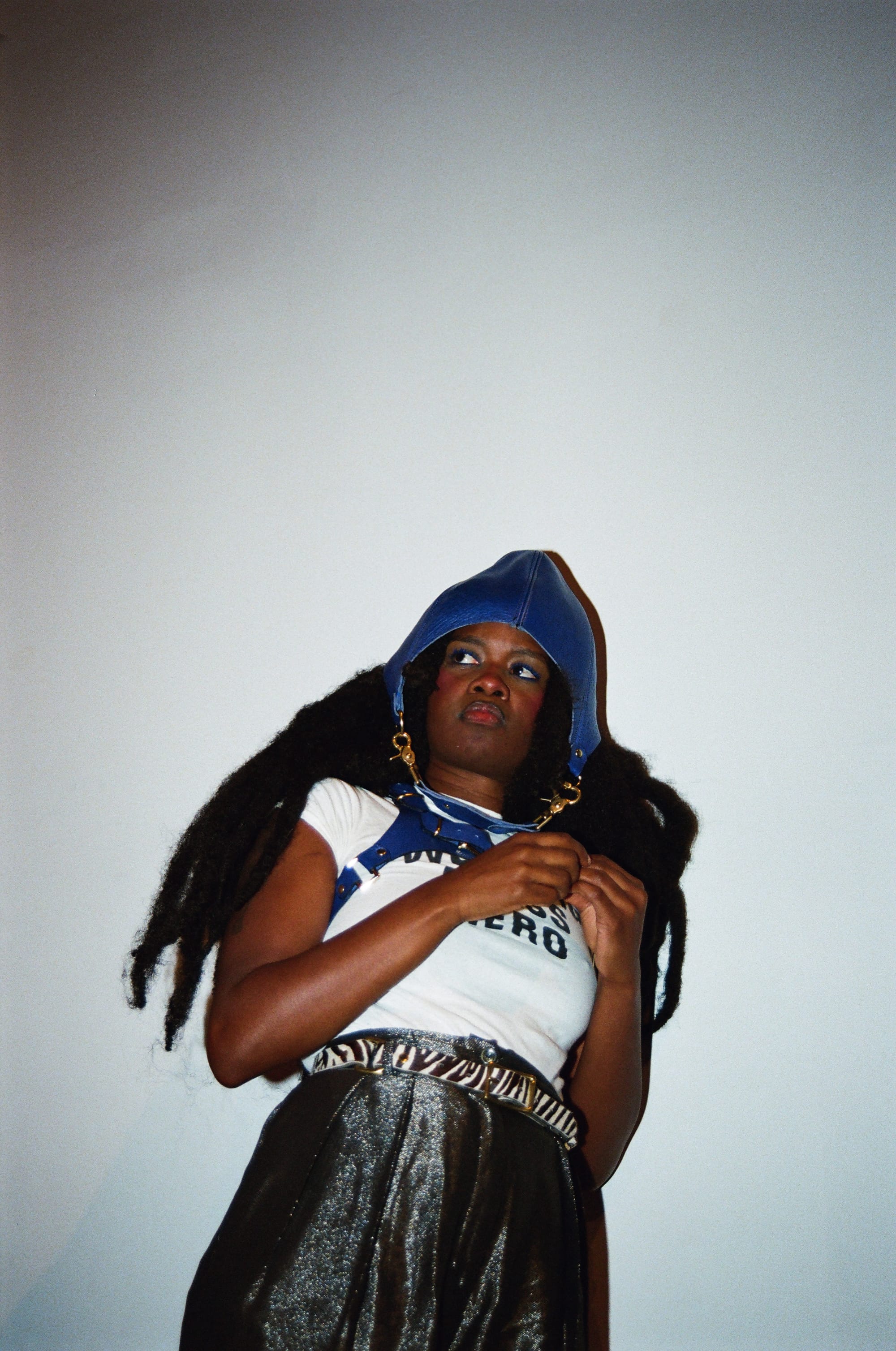
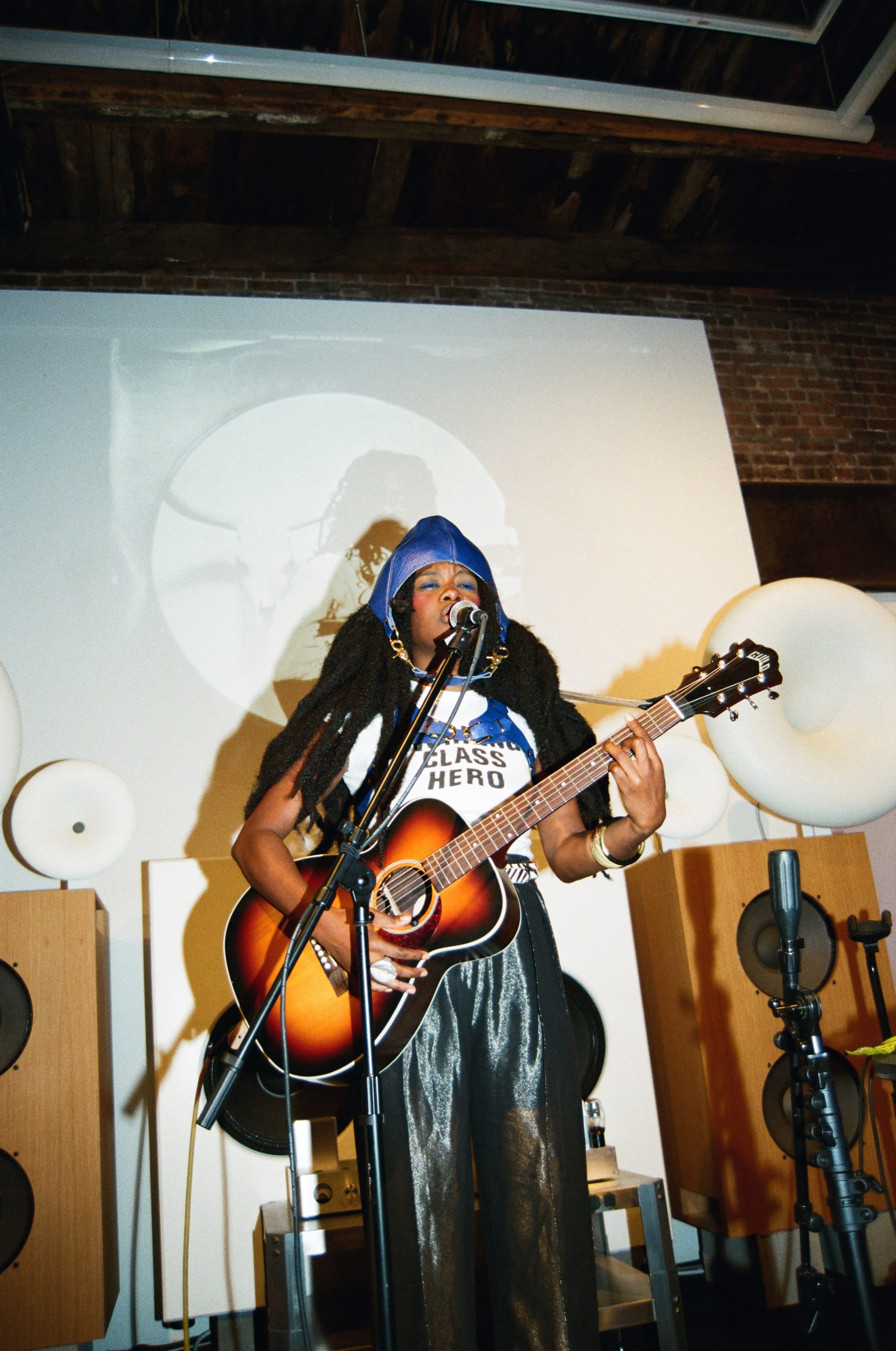
Reed on November 3, 2026. Photos by Matthew Schonfeld
Reed grew up as Ella Josephine Julia Moore in Washington D.C. and New York. Their parents are both writers, and Reed was omnivorous about music early on, playing percussion, guitar, and singing in the DC Youth Orchestra, at the Harlem School of the Arts, in punk and hardcore bands, and at Berklee College of Music, where they studied electronic production and design. They’ve had the education, but their artistic framework is inextricably tied to their values and their community. The music influences how they live.
Making Is This How Empires Die?, for example, “has helped me grow as a human being and has helped me enrich my spirit,” they say. “There are so many things that have changed about me in the process of making this EP, in particular the ways that I have communicated. I feel like these ideas flow out of me, and I have no explanation as to who I will become in the midst of creation, but then as the work sits with me, I start to live by the ideals that are in the music.”
Even the process of writing “American Dream,” which they’ve been working on for years, took time to evolve. Reed explains that at first, they were trepidatious about naming a song “American Dream” as an anticapitalist— “I wanted to make sure that the politic of the song didn’t feel pandering or performative, that it felt in alignment with my personal views”—and was unsure about interrogating such an idea after Cuntry. “It’s just like, ‘I wrote this whole anti-imperial work. It’s weird to continue in this direction.’”
Yet questioning structure is at the center of Reed’s music—both aesthetically as a songwriter and producer, and intellectually, as a lyricist and thinker. And part of what makes their music so compelling is the tension between their vigorous critiques, their often acerbic lyrics—I think about “life on the clock’s like eating with your eyes,” from their working-class anthem “Salt n’ Lime,” near daily—and the sheer beauty of their songs. On “Rubber,” a country-folk song on Is This How Empires Die?, they sing of Black American resistance with profound warmth, invoking a singalong chorus that sounds like angels praying: “I will be rubber to youuu, no matter what you will do. I will be rubber to you.” It’s a bit sorrowful, but midway through, the song modulates a half-step to a major key, personifying power in numbers. As Reed embodies their music as they write it, we can also take away the same messages, the way community manifests not just in their lyrics but in the way they compose songs.
There’s also a poem on Is This How Empires Die?, written and read by the writer Nikole Hannah-Jones, a close friend of Reed’s mother. Hannah-Jones embraces the prompt, situating the EP in our current moment, but also all the American moments before that. She wonders if empires die “in myths buckling beneath their own weight/In foundations that were cracked from the beginning/In the lies our teachers told us, or the ones we told ourselves/In centuries of lethality to protect our borders, when the real enemies were always within.”
Reed calls Hannah-Jones “an incredible example of so many things, but especially Black historical work and work around education,” and says her contribution helped focus Is This How Empires Die? “What she says about ‘myths buckling beneath her own weight’ reminded me that, Yes, this is literally what the project is about,” they say. “For me, it is inescapable to live and make art that reflects my current reality. These are the things I’m thinking about, these are the ideas that are flowing through my brain every single day—and the brains of so many. And I think that, in a world where discourse is often elevated or prioritized over the fact of the human condition, in a lot of ways it will be a difficult road for me with music and songwriting. People will interpret this music any way they want to. And I think that my duty is to surrender to that—and to just continue to write from the things I see.” Their vision is salient, their aim is true.


