Who Plays Metal in Morocco?

An inside view of how one music scene fought to exist—and came to flourish.

Who Plays Metal in Morocco?
Photo by Chadi Ilias.

The first metal show I went to, I had to take an hourlong train from Fes to Meknes. It was a tribute show to Death, pioneers of death metal and where the subgenre gets its name. My music taste was softer at the time; I liked Dio and Savatage, and the melodic death metal band Amon Amarth was as far as I’d venture in the screamier realm. I just wanted to hear “Voice of the Soul” live, really. It was a 2017 afternoon, and my friends and I sat outside the venue waiting for the show to start. Delays of two hours or more were the standard at the time. And when the musicians finally played, the drums towered over every other instrument. The mic broke down every few minutes while a frantic sound guy fought to fix it. None of that mattered. We all loved it; we loved that we could enjoy this music with what really felt like a community. We were moshing to death metal in Morocco with no fear.
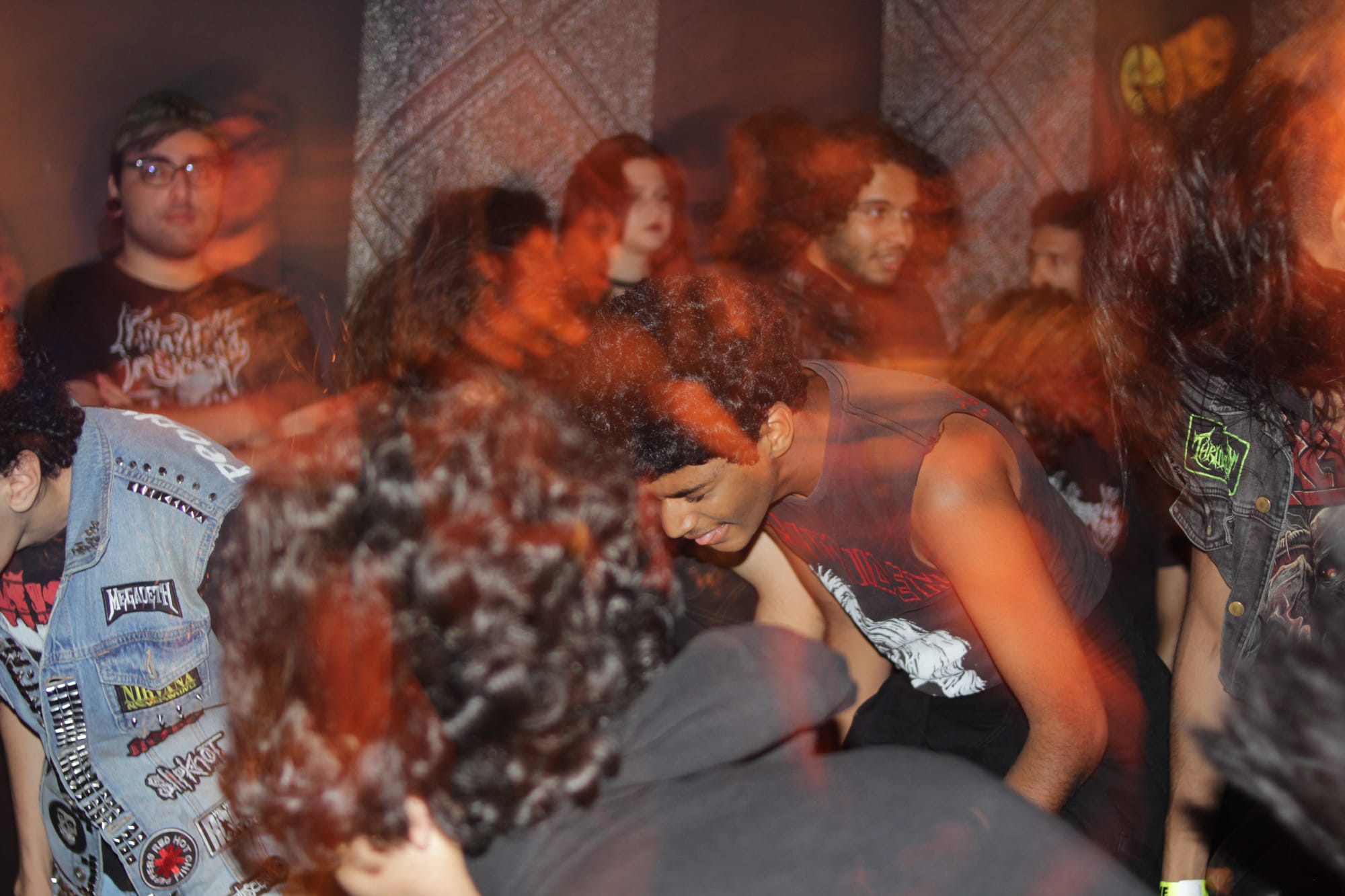
The mosh pit at a local metal show. Photo by Akram Herrak.

What really started it all was MTV. The popular music channel hit Morocco in the early 1990s, and young viewers got to watch the weekly show Headbangers Ball, a three-hour compilation of metal performances and new releases. The rich kids watched it on satellite TV, while those who couldn’t afford it got it on black-market VHS tapes. A few years of weekly exposure was all it took for the first bands to form in Morocco. Immortal Spirit, a death metal band that started out covering their favorite bands, paved the way in 1996. 

By that point, metal had reached dark depths—its last attempt at mainstream popularity, glam metal, had been left behind in the 1980s, and the heavier sounds of Death, Morbid Angel, and Cannibal Corpse were emerging from obscurity. These were the sounds that influenced metal in Morocco: It was heavy from the start, and that never really went away. A couple of bands experimented with tamer inspirations, but an audience that gets to experience two or three shows a year doesn’t want progressive metal intricacies; it wants the fuel of mosh pits and walls of death. 

Thirteen years prior, 14 metal fans not so different from me ended up in jail over the same joys we experienced that day. In 2003, a judge handed out jail sentences to members of early bands Nekros, Infected Brain, and Reborn—and a few fans as well, just for good measure—after the judge decided the musicians, their CDs, T-shirts, and English lyrics were “satanic.” The government at the time was influenced by an Islamist party, but that 2003 witch hunt ultimately failed. A series of protests and benefit concerts ensued, the King himself intervened, and the kids kept playing their guitars. By the time I started going to metal shows as a conspicuous teenager with long hair and Megadeth T-shirts, it was totally OK to rock out, if you didn’t mind a few mean comments as you walked in the street. 

Badr, drummer for Vile Utopia. Photo by Akram Herrak.

At that first metal show I attended, musicians from all over the country had selected an all-star team to pay tribute to Death. In the small venue during the blazing summer heat, a few dozen of us headbanged; being there felt like a revelation. And from all the performances I saw that afternoon in 2016, I remember Aissam, the vocalist, most distinctly. This tall, skinny dude with crazy dreads gripped the microphone tight and made sounds straight out of hell. He “sang” Death’s punishing 1987 song “Zombie Ritual” with his eyes rolled back and his dreads headbanging into a tornado.

A year later, we had become very good friends through the metal scene (and our shared interest in retro video games and comic books), and when I moved to Casablanca in 2021, Aissam ended up being my neighbor. When it was my turn to scream my lungs out with my band Surged Fate, he was the one behind the monitor. We had fashioned our own DIY recording booth by hanging towels around a tiny corner.

A guerrab, or traditional water-seller, at L'Boulevard Festival 2023. Photo by Akram Herrak.

Morocco’s metal scene is flourishing these days, and although I haven’t been home in a couple of years—I’ve been on one long trip around the world since 2024, writing and taking photographs—I still hear about the new bands emerging. It’s easier than ever not only to make music, but to reach a global audience from Morocco. The Settat-based black metal band Pagan Ulver, for example, released their first demo in 2023; a year later, they won first prize at Tremplin-L’Boulevard, a music festival and competition in Casablanca; and a year after that, they opened for Katatonia, the Swedish metal giants. The Temara-based thrash band Manic Attack emerged in Pagan Ulver’s wake and are making similar strides. Godspeed, you wonderful young musicians.

As for myself, I belong to the generation just before this one—and, by extension through friends, to a couple of others before. Metal fought to exist in Morocco, and I spoke to a few of the musicians—Aissam, Souhal Ahenjir, and Wassim Ahenjir—who helped make it happen. 

Aissam. Photo by Akram Herrak.

Hearing Things: I was introduced to metal when Dio cameoed on South Park. Do you remember what got you into it? 

Aissam: It was in the ninth grade. A classmate handed me a burned compilation CD with “METALLICA” written with a marker pen, and he said I’d enjoy the songs by Linkin Park and Slipknot. Before that, I listened to hip-hop, and my parents played the Beatles in the house. He was right. I got into it, I bought an MP3 player and copied the songs onto it, and by the time I got to high school, I was already dabbling in more extreme music. I moved to Oujda [a city at the border with Algeria] after high school, at the age of 16. I was walking in the middle of nowhere wearing a Cannibal Corpse T-shirt, and I saw a dude wearing the exact same shirt. He showed me around the local scene, where each clique hung out, and then he invited me to a rehearsal. These guys were playing in a garage, and they needed a vocalist. When I was a kid, I did choir in school, and I started trying metal vocals in high school. I wasn’t a pro, but no one in the band was: we decided to call it Graveyard. We played a mix of black and death metal with an oriental flair—percussion on the Derbouka and Arab drum patterns.

I never thought there was a metal scene in Oujda. What was that like? 

It was actually pretty active for a couple of years. The main venue was Cinema le Paris, and it cost 2000 DHS [around $212 USD] to rent it for the afternoon. The main band was Metalvana, a Metallica tribute band with two sets of brothers who had one original song called “Kill Your Friends.” The sound was shit because sound engineers were used to working weddings and not metal shows, and it got dangerous, too. Local thugs would sometimes show up after the shows—even during the shows. I remember one time, the moment we wrapped up, we packed up our stuff and ran for our lives. 

Tagrest. Photo by Akram Herrak.

You later moved to Casablanca. How was that scene? 

I remember going to a show with some friends in 2012 to see local metalcore band Hold the Breath. The guitarist, Zakaria Najim, was playing some slam riffs during soundcheck, and I went, “Fuck yeah, man, slam rules!” Right after their set, we started talking about bands like the Faceless and became good friends. We joined the band Suicide Machine for like a month before quitting and starting our first band, Infected Noise. He played guitar, I switched to drums, and Nada [Kucsulain] was our frontwoman. We played a few shows, we played a tour with a band from Switzerland called Vale Tudo, and all of this lasted a couple of years. During that time, we met Badr [Abdouessaoud], and Zakaria met Nabil [Rafiq] on his own. We all liked technical death metal, and the four of us started Vile Utopia. We were focused on writing music more than gigging, and when our drummer moved to Ukraine for a few years, I did a bunch of collaborative projects. Zakaria had his own projects, Guterus and God Has Remembered, and I did vocals for a few songs. I did projects with bands from the U.S., from Pakistan, and from Morocco, of course. I recently joined We Come For War, and that’s been pretty awesome. 

How has it been playing metal all these years? What changed? What were the highlights? 

It’s been a crazy ride. Back in the day, you had no equipment to record: Our first demo was recorded by the local rapper who knew nothing about mixing a metal song. Sound during live shows was always hit or miss, and often all you could hear was the drums, but people were happy. Now, everyone can get access to good equipment; venues like Boultek in Casablanca take care of everything when it comes to concerts, and at a high standard. Once a year, we get L’Boulevard; we’ve had so many awesome bands come and play, like Sepultura, Septic Flesh, and Gojira. When Sepultura were playing their set, they got the news that Ronnie James Dio had died. It was the 16th of May, 2010, and they improvised one of his tunes on the spot. 

The highlight has been playing on that stage myself. It’s a completely different and surreal experience, and it was awesome.

I can vouch for that, I was there.


During my conversation with Aissam, he mentioned Thrillogy as a band that has really pushed the boundaries of the genre locally. So I called the band’s two guitarists/vocalists, Wassim Ahenjir and his brother, Souhail Ahenjir—both of whom also happen to be my friends from the scene in Fes, circa 2016. 

When I asked each brother what got them into metal, they both credited late-’90s Sega videogames, and the curiosity that 16-bit rock sounds sparked in them. Their first memories of metal were the same: Linkin Park and Slipknot. Wassim got an acoustic guitar as a graduation gift one year, and said that when they attempted to play Death’s “Lack of Comprehension” on its strings, their mom thought it sounded like an oud. After a couple of years of saving, the brothers were able to afford their first electric guitar, and their metal started sounding like it’s supposed to. 

Souhal Ahenjir. Photo by Abdelhamid Belahmidi.

Souhal Ahenjir: Both my brother and I started out in small, makeshift bands where we covered classic rock songs—stuff like Scorpions and Metallica. A friend of ours, Zakaria Fallah, used to come to our house when we were teenagers learning guitar, and when Wassim left for Casablanca after high school, he and I started jamming together more, and we started talking about starting a band. I must’ve been around 15. Zakaria knew some local musicians; he was a lot more social, and that’s how we met our drummer, Abdellah [Britel]. We decided on the most cliché name in metal, the Nameless, and played a couple of shows where we covered stuff like “Enter Sandman.” We eventually wanted to do our songs, one thing led to another, and that became another band, Torpedo

We used to rehearse in a youth center on the outskirts of Fes; we’d take the bus there with our instruments, Abdellah with a full acoustic drum kit in a carry bag over his shoulders, and after a while, the director finally gave us access to a room where we could keep our instruments. 

Fes had an active music scene at that time, and local bands would play shows a few times a year in a couple of venues, mostly in Cinema Boujloud in the old Medina. 

We used to play in a couple of places in Fes. The youth center downtown had a good enough stage, but the spectator area was all seats, and metalheads like to mosh. The director grew to hate us—not unprovoked, because there would be some collateral damage from time to time—and people preferred the shows we played at the cinema. It had been abandoned for some time, it had no seats, and the owner was happy to get some cash, but it was bare. You’d agree on a fee with the owner, then go to a wedding caterer where we’d rent equipment like the soundboard, cables, mics. We’d call a couple of bands who were happy enough to pay for their own transport and play for free, just to play, and if we limited our losses to 1,500 DHS or something, that’d be a huge success. We thought of it as the cost of playing live. 

Wassim Ahenjir. Photo by Chadi Ilias.

Wassim Ahenjir: We started Thrillogy in 2012 when I was 18, just to play a show at our university and cover some classic rock tunes. We loved playing live, we loved playing music, and each of us in the band had different influences in metal, and we agreed on thrash as common ground. Throughout the years, we put in a lot of effort and tried different things that people had maybe not thought of at that point, and we were never nervous about it. We were in it for the love of the music, just because we wanted to play music, and I’m proud of what we’ve done.

Things really started to change and improve at one point, and now, the musicianship and production value of Moroccan metal is indistinguishable from that of any big bands; just listen to a song by We Come For War, and it’s comparable to deathcore giants. 


One of the beautiful things about a local scene is the familiarity. Wassim said that he sees the same 200 to 300 people, no matter the city, no matter the band. It’s a small but very dedicated community. Thrillogy has had a couple of members come and go, though. People move away for studies, they get busy with work, and life just happens. For a few years before Souhail left for Germany, the two brothers were fronting the band together. “I wouldn’t be able to ask for a better bandmate,” said Wassim.

In 2022, when Thrillogy was in the Czech Republic with some friends for the festival Brutal Assault, they struck up a conversation with the members of Krosno death metal giants Decapitated and suggested that they play in Morocco. The Poles asked about the country and the scene, and that was that. A few months later, Wassim got the call that Decapitated were headlining L’Boulevard that year, and that Thrillogy would open for them. Both brothers call it the highlight of their metal career. 

This is but a slice of Moroccan metal, snippets from conversations I’ve had about the struggles and the joys of playing a genre of music in a place where it was once jailable. There are so many wonderful bands and musicians who’ve given so much to the scene, and it’s really paid off. There’s an actual scene—an actual community—and more chances than ever to start a band. 

In 2021, when I was new to Casablanca, I used to share vocal covers of bands like Lamb of God and Lorna Shore in the Facebook group Moroccan Metal Community. A few guys tagged each other a couple of times, saying, “This guy’s vocals are good.” Whether that was true or not, we ended up in Surged Fate together, and a lifelong dream of mine had come true. In our first jam session, we covered Lamb of God’s “Vigil” and I was there, singing—or, more precisely, screaming—live with a drummer, a guitarist, and a bassist. What comes out of playing music in a local band? Most of the time, nothing—but it’s some of the most fun nothing to be had in this life. 

So if you like your music heavy, to paraphrase James Hetfield, give Moroccan metal a chance. There is so much so much talent, and an energy that has been building up for a long time—even from a distance, it’s perfectly clear that it’s bursting now. While I travel, whenever I can, I hit up a local metal gig and jump into their scene, and I’ve found the same enthusiasm everywhere (shout out to the local bands of Ho Chi Minh City, Vietnam). Metal has never been a popular genre, and it never will be; it is an underground culture, with all the pros and cons that come with it. But the passion of the Moroccan scene is yet to be matched anywhere.

More Features

Read more features

Great! You’ve successfully signed up.

Welcome back! You've successfully signed in.

You've successfully subscribed to Hearing Things.

Success! Check your email for magic link to sign-in.

Success! Your billing info has been updated.

Your billing was not updated.