


Liz Pelly on the Impact of Her Anti-Spotify Book ‘Mood Machine’ and Where We Go From Here
“The point is to encourage people to reject the idea that it’s a one-click solution.”


Since its publication a year ago, Liz Pelly’s Mood Machine: The Rise of Spotify and the Costs of the Perfect Playlist has become the go-to resource for anyone who cares about the meaning and worth of music in the streaming era. It’s a damning critique of the industry’s biggest streaming player, Spotify, that lays out how the company’s crass practices have served to turn music—our most visceral art form—into a background concern while devaluing it in a very literal sense, too. Through deep reporting and an unwavering ethical framework, Pelly took Spotify to task. As the book became a national bestseller, the streamer’s continued misdeeds were put under a microscope throughout 2025, leading to a steady drumbeat of negative press and many artists leaving the platform in disgust.
But when we meet at a Brooklyn cafe to discuss Mood Machine and its impact, Pelly doesn’t seem interested in dunking on Spotify yet again. Instead, she’s most excited to show me the guest book that she asked readers to write in during her globetrotting Mood Machine tour. The black notebook is filled with signatures, stickers, and notes of appreciation and DIY communion, some of which run several paragraphs long.
“When you write a book like this, you’re supposed to write for the most general audience imaginable—but for me, there’s a point where, if I’m trying to write for everyone, I end up writing for no one,” she tells me. “So I started imagining this moment after it was published, where I was having a book talk at a used record store, and thinking about who would come, and then writing for those people.”
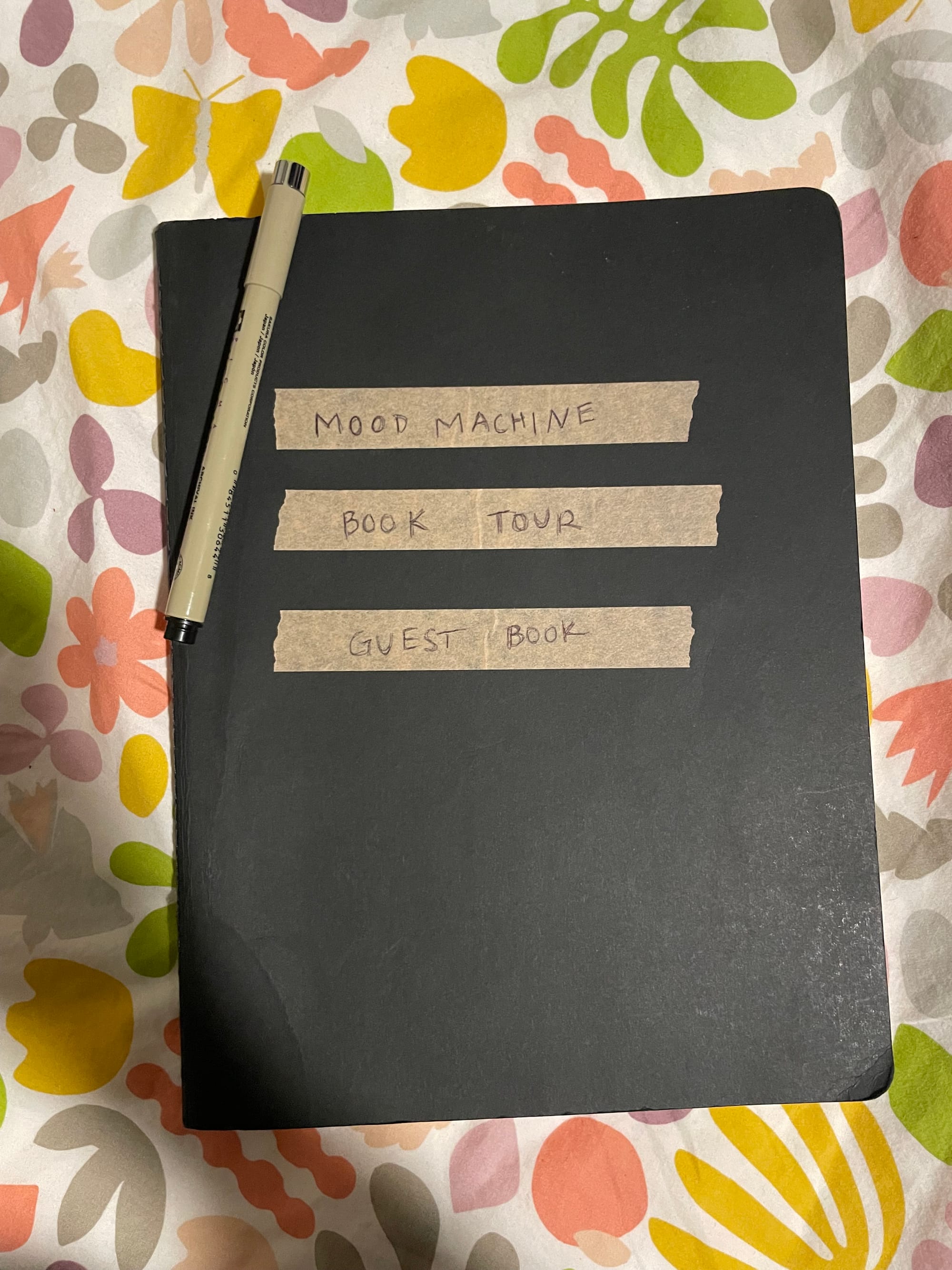
Flipping through the guest book, she recalls how that imagined scenario came to be at Joint Custody records in Washington, D.C. the same week the book came out, and how people lingered there to discuss issues raised by her writing. The same thing happened at a small bookstore in Lisbon. In Melbourne, Australia, she spoke with a group of graduate students studying the platformization of music, where everyone formed a circle with their chairs and tossed questions and ideas across the room. One of her most memorable stops was in Lawrence, Kansas and organized by an all-ages booking collective alongside a local bookstore and record store. “It was this really nice reminder that there’s cool music scenes in small towns everywhere,” she says.
More than anything, Pelly hopes her book continues to facilitate this kind of active conversation and interest in alternatives to the music industry’s current status quo. Because long after Spotify and its ilk are relegated to the tech scrapyard, Pelly will still have her principles. She’ll still be able to consult her guest book, and dream up new ways to further the camaraderie found within it.
Get access to everything we do at Hearing Things—including weekly album and song recommendations along with our ever-growing archive of interviews and reports—with a free 30-day trial!


