One Night in a Haunted Mansion With Slow Pulp
The heart-on-sleeve rock band’s frontwoman Emily Massey speaks to the spirits—and us—about lore, her musical inheritance, and what it means to grow up.


Emily Massey’s voice floats through the spooky old mansion with a longing that could break a ghost’s heart. The Slow Pulp singer sounds both ragged and determined as she runs through “Spill,” a bleary slow-burner from the Chicago-based band’s third album of aching indie rock, Melodie. “So could you tell me you love me/Say it out loud/Wanna find out,” she pleads to an empty billiards room during soundcheck. Disappointment is embedded in her delivery, as if she already knows she’ll never hear those three little words of affection from that one particular person ever again.

Corus is a social app for sharing and discovering music. Post your favorite songs and match with people that share your taste. Follow @hearingthings on the app too!
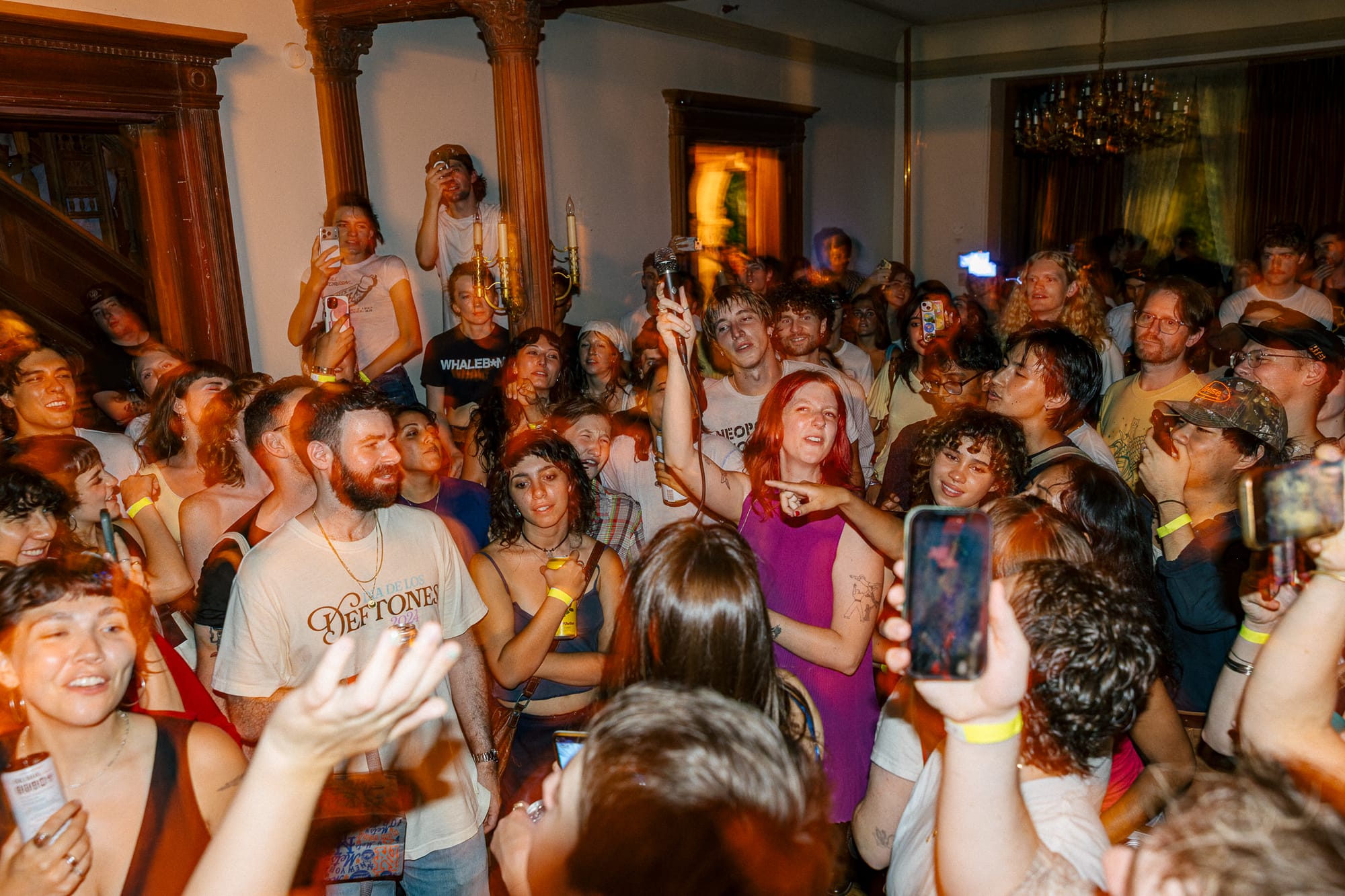
It’s late August in Bed-Stuy, Brooklyn, so humid the mosquitos are flopping sweat as they swarm. In a few months, Slow Pulp will play for nearly 3,000 people in a venue a couple of subway stops away; on this evening, only about 100 fans will perspire alongside each other in this poorly ventilated manse known as The Hancock for an acoustic performance. The 10-bedroom home was built in 1887, and its history seeps out through the mauve wallpaper. Rumor has it that President Grover Cleveland, who was friends with the original owner, loved staying here. Fast-forward more than a century, and the building was bought by a hotel magnate from the Eastern European country Georgia for more than $6 million in 2018. Since then, it’s served as a haven for struggling artists, who were granted rent-free stays; a post-pandemic party destination, before it was shut down by the cops; a home for the current owner’s wife and kids; an impromptu mud-wrestling ring; and a concert venue with considerable character.
From the outside, the mansion looks like the perfect location for a slime-spewing set piece in a Ghostbusters movie. Inside, it seems as if these rooms have still only ever been lit by long, dripping candles. There are chandeliers that look like they’re made from petrified snakes. A framed painting of 19th-century men berating a demure woman. A tiny hobby horse figurine on the mantle. Various drawings of ballerinas. A three-foot statue that vaguely resembles Chuck Norris.
As Massey’s eternal lonesomeness continues to echo through the space—Tell me how I’m supposed to feel/Is this part of the city life?—I think about the lives that once played out here. Maybe this band’s plainspoken songs could have unlocked empathy in the gentry of yore. Maybe maids and minders of the Gilded Age would have found solace in Massey’s comforting rasp. When they’re composed with adequate grace, maybe expressions of desire, grief, and doubt don’t ever really age at all.

After soundcheck, Massey takes a seat on the other side of a long couch. In black boots, a magenta top, and hair the color of red Jolly Ranchers, she’s cheerful and polite, with an easy laugh. “We’re just Midwestern folk at the end of the day,” she says of Slow Pulp, which formed about a decade ago in her hometown of Madison, Wisconsin. “What’s very Midwest is to be open—to a point,” she explains. “There’s a quiet stoicism, stubbornness, and old-fashioned ego that is embedded with us, along with a goofy friendliness.”
That mix of approachability and resilience, along with a sound that sometimes harkens back to ’90s grunge and shoegaze, has taken them well beyond the middle of the country. The quartet—which also includes guitarist Henry Stoehr, bassist Alex Leeds, and drummer Teddy Mathews—has opened for Pixies and Death Cab for Cutie, whose frontman, Ben Gibbard, once said Slow Pulp’s music helped get him through the pandemic. He’s not alone. While their style nods to simpler times, the despondency in this band’s songs speaks to our doomscrolling era, when it can feel like a considerable feat to make it through one more overloaded day.
Melodie is their shiniest, and saddest, album to date. With the band members now entering their 30s, the stakes of these songs are higher. Breakups become indictments of selfhood. Depression is debilitating. Losses accrue, with no real end in sight. Misery and its company. The music aims for the core of your being, and it hits. Again and again.
For every sparkling, would-be arena anthem like “Better Man,” there’s a devastating ballad like “Not for Nothing,” which recalls the classic pop songcraft of Aimee Mann. Massey branched out as a lyricist too: For the fuzzed-out track “Entertainer,” she tried to step outside of herself and into the shoes of the one and only Stevie Nicks. Massey was inspired by the Fleetwood Mac legend’s notoriously messy relationship with her bandmate Lindsey Buckingham and wondered, How much did they let the lore fuel the songwriting? The result is a little cheeky—and it made me curious about whether there’s ever been any romantic lore within Slow Pulp over the years. “There’s some lore—that’s what I’ll say,” she says with a smile. “But nobody needs to know.”
One of the album’s themes is self-confidence, or more specifically, a lack of it. On the new-wave-ish “Red Car,” Massey admires someone who’s so sure of themself, while she’s still stuck in neutral; on “Like Me,” a slowcore dreamscape, she admits to feeling as if she’s essentially unlikeable. No matter how many accolades or sold-out shows Slow Pulp rack up, this struggle is real for Massey. “I’ve spent a lot of time faking some sense of confidence, especially as a performer,” she says. “I used to be very self-conscious and rooted in a lot of self-hatred that I had to work hard to attempt to undo. So much of that self-hatred is so rooted in control, and it almost feels like a comfort in being like, I know I have trouble liking myself, and I can accept it. But what shifted for me recently is a letting go of control and an acceptance of inconsistencies. There’s a weird newfound confidence in myself because of that.”
Some of that self-assuredness can be heard on the gorgeous tearjerker “Slip Away,” which was written by Stoehr. While Massey and Stoehr were working on vocal ideas for the track, the singer surprised herself by going for a big, belting moment. When she turned around, her bandmate’s mouth was wide open in astonishment. “Then I heard it back and I was like, This is pretty good,” she recalls, repeating the words of affirmation in a conspiratorial whisper.
Throughout the record, Massey’s voice is more present than ever before. She’s proven herself to be one of the decade’s most affecting rock singers, like a less serrated Courtney Love or a more sober Paul Westerberg. She never took singing lessons, though she’s been around music her entire life. Her father, Michael, has been a fixture of the Madison music community since the 1970s, when he peacocked in shaggy blond hair as the leader of a glam-rock band called Chaser.
Emily didn’t always want to emulate her father. “Growing up people expected me to be into music because of my dad, but my form of rebellion was to be like, Music is overrated and lame,” she says with a laugh. Instead, she spent her youthful creative energy studying ballet—until a fateful day in her high school years when, during dance class, she did a big back bend and felt a crunch in her spine. She ruptured one of her vertebral discs, dashing her ballerina dreams. The upside: She decided to keep her artful inclinations engaged by joining her first band.
Emily says her dad didn’t push her into music, though he was pleased when she finally took to it. He was likely also wary, given his own history in the business. As Michael recounted in his 2023 memoir More, his band Chaser was once courted by Atlantic Records, to the point that the label spent tens of thousands of dollars for them to record a demo in the same New York studio that once hosted the likes of Led Zeppelin and Charles Mingus. Then the deal went poof, and so did Michael’s fantasies of rock’n’roll superstardom. Even worse, in his mid-30s, Michael almost suffered an early death following two decades of alcoholism.
In 1993, after getting to the point of drinking at least a fifth of hard liquor and a 12-pack of beer each day, he quit cold turkey at the behest of his wife Robin. Then Michael looked in the mirror and saw his teeth melting. His alcohol withdrawal was triggering hallucinations, and he imagined three-foot-tall trolls wearing burlap sacks and grimy hats climbing onto his dresser. He checked into the hospital, frenzied and hysterical. He was so far gone when he got to the ER that the doctor said he wished the episode was being videotaped as a deterrent for kids who were thinking about drinking themselves. It was the beginning of a long recovery. Then, on October 13, 1995—exactly two years to the day that Michael had his last drink—Emily was born.
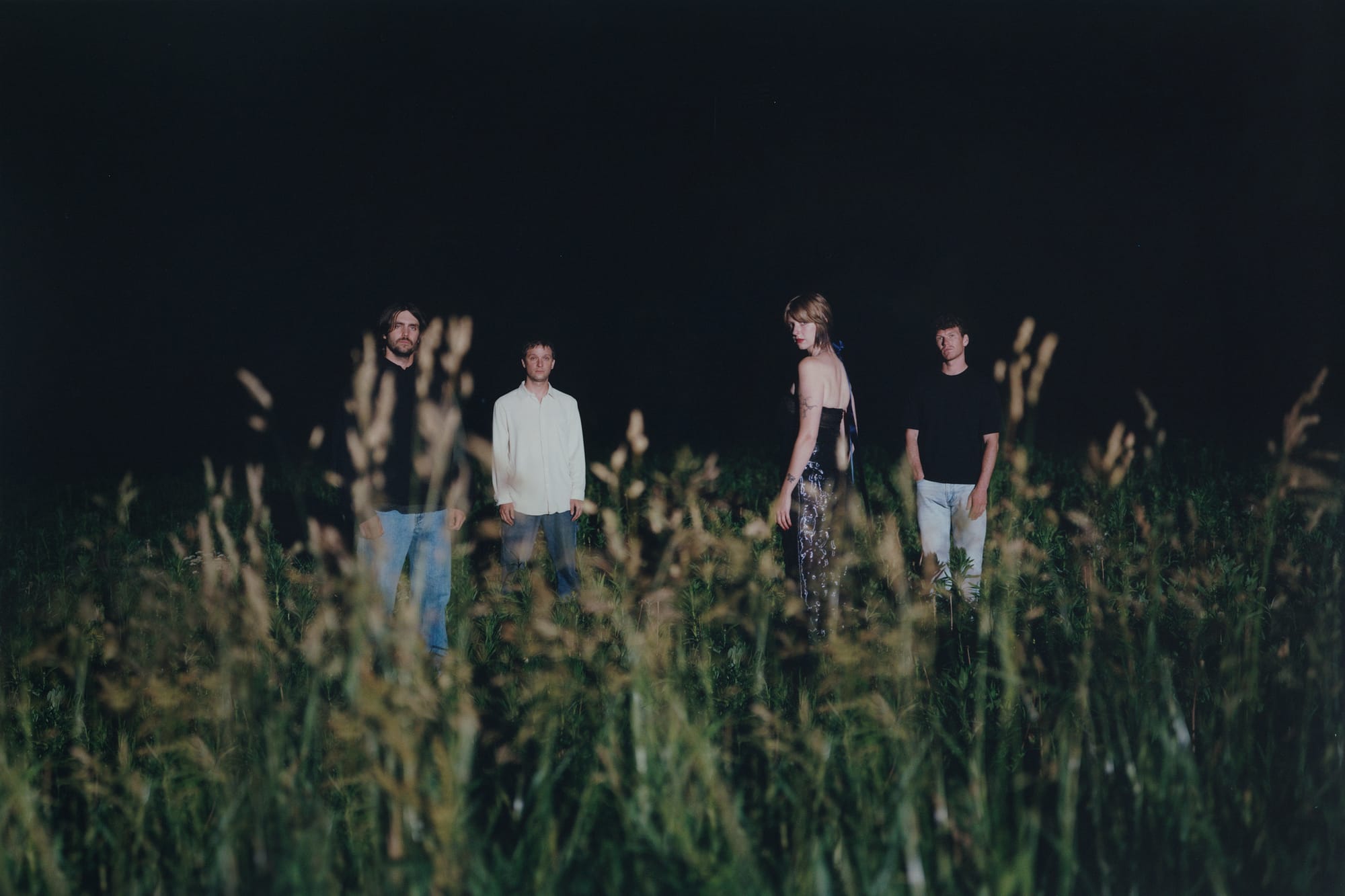
At this point, Emily and her dad aren’t just fellow musicians. They’re collaborators. For all three of Slow Pulp’s albums, Emily has recorded her vocals with her dad, just the two of them. “It is not normal,” she admits. The tradition started in 2020, when Emily’s parents were in a car accident in which they suffered spinal cord injuries and concussions, and were hospitalized. Emily rushed home to be with them just as the Covid lockdowns began. At the same time, Slow Pulp were trying to finish their debut album, Moveys. So Michael and Emily draped quilts over lighting poles to create a makeshift vocal booth in the family dining room, and got the job done.
For subsequent records, the pair relocated to a more professional setup in Michael’s new house, though their complementary working relationship has remained constant. “He likes to let a take have certain imperfections, which I’m scared of,” Emily says of the sessions. “He is really good at pushing me into a direction that’s more emotional. We’re so close, so he knows a lot of the context of what the songs are about, and he doesn’t let me hide from that.” She’s quick to add that they don’t always agree on every decision, including ones about certain vocal harmonies. “Sometimes he’ll be like, ‘This is like a weird Gregorian choice,’ and I’m like, ‘Well, I want it to sound kind of medieval, let me have it!’”
Michael now proudly refers to himself as a blue-collar musician, and he’s made a career out of playing his own music, performing in cover bands, and composing for commercials and films. (He also made it to the TV talent show Star Search in 1986 with a band called Boys in White, where he sported an incredible feathered mullet.) “I’m struck how my definition of success has changed over the years,” he wrote in his memoir. “The younger me wanted fame and fortune, limousines, and tens of thousands in the audience. Now I’m touched and consider it the highest compliment when someone reaches out and says my music comforted them in their time of need.” It’s a sentiment that Emily unwittingly echoes in our interview. “The highest compliment to me is when someone projects their own stories onto the songs, and that it meant something to them,” she says. “I hope that connectivity is always going to be the takeaway from our music.”

With the mansion full of sweaty Gen Z fans, and maybe a few curious ghosts hovering above them, Slow Pulp take their place in the back of the room. Near the beginning of the performance, Massey offers something of a disclaimer. “We’re doing a stripped-down set, so maybe try to keep the talking to a minimum,” she suggests, reasonably, before self-consciously bending her own rules. “Boring! I know. Or talk, just don’t watch.” Sitting behind her with his guitar on his lap, Stoehr quietly adds, “Or sing along too.” “Singing along is incredibly encouraged,” Massey confirms.
Throughout the gig, Massey leans into the unusually intimate atmosphere, balancing her band’s beautiful songs of woe with playful banter. “Anybody on their period right now?” she asks the crowd at one point, to a few scattered Wooo!’s. “Me too!” she laughs. “I actually just got it yesterday.” Ooooh! goes the audience. “This song’s for anyone dealing with it—it’s called ‘Cramps.’”
The show hits a communal peak with Slow Pulp’s most popular song, 2020’s “Falling Apart.” Massey wrote the lyrics while she was taking care of her ailing parents after their car accident, a period of time when she had to put on a brave face and grow up fast. “Why don’t you go back to falling apart/You were so good at that,” she sings on the hook, pining for a time of lost innocence. As she delivers those lines this night, she wades into the crowd for a cathartic sing-along. She holds the mic above her head, high enough for the spirits to join in.