Radiohead’s Ed O’Brien on the Guitar That Defines His Haunting Sound

How the art-rock icon used a specific instrument to add uncanny atmosphere to so many Radiohead classics as well as tracks from his new solo album.

Radiohead’s Ed O’Brien on the Guitar That Defines His Haunting Sound
Photo by Steve Gullick

Gear Crush is a column in which we ask some of our favorite musicians about the racks, stacks, and instruments they love best.


Like fog enveloping an abandoned countryside, Ed O’Brien can be counted on to set a foreboding mood. In Radiohead, the guitarist’s contributions may not be the flashiest, but they’re essential to the band’s dystopian musings. On the 2000 classic “The National Anthem,” from Kid A, Colin Greenwood’s grimy bassline pops out early on, yet O’Brien’s drones make it clear that the song is far from your standard rock rallying cry. He provides similarly spooky ambience throughout Radiohead’s discography, on tracks like OK Computer’s “Lucky” and In Rainbows’Jigsaw Falling Into Place.” This billowing style is far from O’Brien’s only mode on the guitar—and, by the way, he also happens to be one of the most effective backup vocalists in alt-rock history—but it is his most memorable.

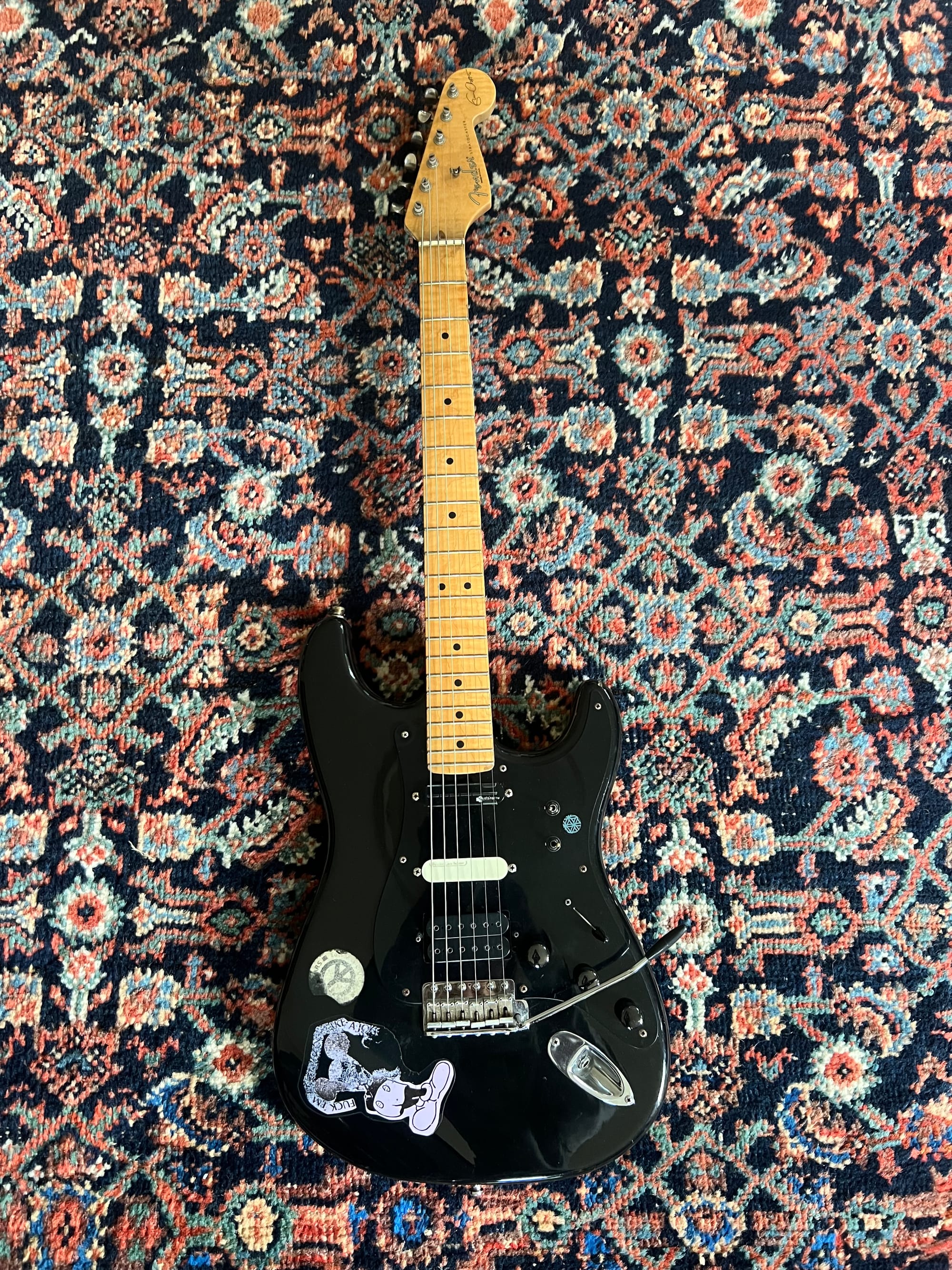
To create these eerie soundscapes, he’s returned to the same guitar over and over across the last 30 years: a black-on-black Fender Eric Clapton Signature Stratocaster, souped up with a sustainer pickup that extends its tones toward infinity. This bespoke model allows O’Brien to conjure entire universes of electronic-seeming textures that sublimely subvert the bluesy classic rock the guitar’s namesake is known for.

“It’s just got the juju,” he tells me via video late last month, still sounding in awe of the instrument’s powers. He’s sitting in a Los Angeles hotel room with the lights off and the shades open, the impromptu lighting casting a noirish shadow on the right side of his face. He affectionately refers to the guitar as his “Mouse Strat” because of a sticker on its body of a Mickey Mouse-like figure giving the finger alongside the words, “FUCK ’EM IF THEY CAN’T TAKE A JOKE.” He stuck the decal on during the OK Computer tour in the late ’90s and never took it off. Now, after decades of wear, about all you can make out is Mickey’s buttoned trousers and floppy shoes.
O’Brien also made good use of the guitar, alongside several others, on his recent second solo album, Blue Morpho. The record, which was produced by Adele hitmaker Paul Epworth and features an enviable supporting cast including jazz guru Shabaka Hutchings, eclectic go-to session guitarist Dave Okumu, and Radiohead drummer Phil Selway, is a shapeshifting affair. O’Brien and his collaborators meticulously move from pastoral psychedelia to melancholy folk in the lineage of Nick Drake to distorted funk that recalls U2’s Achtung Baby. You can hear the Mouse Strat in the middle of the brooding opener “Incantations,” a heady spell of a song that unspools across nearly eight minutes. It’s there near the start of “Teachers” too, diffusing the track’s strutting bassline. On that song, the 58-year-old paraphrases Dante’s Inferno when he murmurs, “Midway through life I just lost my way.”

Blue Morpho came out of a deep depression O’Brien found himself mired in during the pandemic, when the stillness of the world allowed past traumas to catch up with him. In order to work through the malaise, he turned to one of the most trusted constants in his life: his guitars. He would sit in a tiny spare bedroom in his family’s London house for hours each morning—“It was the only place I could play without disturbing anyone,” he says—staring at the wall and playing. He describes these solitary sessions as a kind of trance. “It was like a semi-meditative state. I didn’t engage my mind, it was much more from the subconscious. You cannot apply your critical mind when you’re in that flow state, because the music needs to just come out, it just needs to be.”


It’s inspiring to hear O’Brien talk about music in such a passionate—and mysterious—way, after all he’s accomplished, after all the lives he’s changed in some way or another. I was 15 when OK Computer came out. At first, admittedly, I didn’t think it was as good as The Bends. But then I kept listening. Soon enough, the album cracked open my taste. It was one of the records that turned me from a music fan into a music obsessive; if it weren’t for OK Computer, there is a chance I never would have become a music journalist. As I talked with O’Brien about his most cherished guitar, there were moments when I had to restrain myself from turning into a version of Chris Farley interviewing Paul McCartney on Saturday Night Live: Remember when you guys did Amnesiac? That was awesome! All things considered, I think I held it together pretty well.

What’s the origin story behind this particular Stratocaster?

Ed O’Brien: I bought it in ’95 when we were on tour in America, after we had all our gear nicked. It’s an Eric Clapton Strat with Lace Sensor pickups. It was the Strat I used when recording and touring OK Computer. It’s on all of “Paranoid Android,” including the distorted parts. “Subterranean Homesick Alien,” “Lucky,” and “Electioneering” had the Strat too, for the more textural stuff.

And then, when we made Kid A, I was fascinated by the whole sustainer guitar sound. There was a Canadian guitarist called Michael Brook, who invented this sustainer guitar. In the ’80s, he actually modified one for the Edge, who famously used it to make those sustained notes on “With or Without You.” I was really intrigued by this, so I managed to speak to Michael Brook, who was a lovely guy. I said, “Listen, I want to make a sustainer Strat, can you tell me how to do it?” And he said, “No—but you can buy a sustainer unit from Fernandes, the guitar maker.” So our head of backline Pete Clements, who’s affectionately known as Plank, put this pickup in, and that guitar became my sustainer Strat. I’ve used it ever since.


The Stratocaster is one of the most iconic guitars in rock history. Were there any musicians you saw playing it growing up that you wanted to emulate?

It’s interesting because what I liked about the Strat was I didn’t have any guitar heroes who identified with it massively. When we got our first label advance I always wanted to get a Rickenbacker because Johnny Marr from the Smiths and Peter Buck from R.E.M. played one, and I just loved the look of them. I did get one, but the Rickenbacker has so much character, and when I was getting into making soundscapes I needed something more neutral. 

The Strat was perfect because it’s got three pickups, very distinct, and it’s got the tremolo arm, which is key for bending notes. I like the versatility of it; you could get different sounds from the pickups, and that’s what I was seeking. I always thought it was a cool-looking guitar, but I chose it because it felt really solid.

So it didn’t have anything to do with the Strat’s classic-rock pedigree?

I never liked classic rock. It was just taking it as a tool, without all the lineage. Strat players like Hendrix and Stevie Ray Vaughan and Clapton are all incredible, but I’m not one of those guys. I came out of a very interesting time as a kid. We had punk and post-punk, which detonated classic rock, and I was very influenced by that. You had these guitarists like Paul Weller and John McGeoch, who’s the guitarist in Magazine, Siouxsie and the Banshees, and PiL. There was Andy Summers, even, from the Police, doing really interesting stuff. Will Sergent from Echo and the Bunnymen. There was the Edge. A lot of these people were not playing guitar in a conventional way. They were my references.

When we were making OK Computer, I only had two guitars: a Rickenbacker and a Strat. The Rickenbacker was great for distorted sounds and arpeggios, but with the more textural stuff, I needed something versatile, and that was the most versatile instrument I could get.

How many guitars do you have now?

I might have 14 or 15, which feels like a lot. I said I wasn’t going to buy another guitar for years, but I bought an Explorer recently. I’ve never had one. It’s beautiful. I don’t need any more guitars, but I love when you pick one up and you feel like there’s some music in it. I still love playing guitar. It still fascinates me.


It seems like your romance with the guitar never waned, which I imagine may have been challenging in Radiohead since the band famously moved beyond guitars in pursuit of reinvention around Kid A.

There were some challenging moments, and that’s why I made the move to the sustainer Strat when we were chucking out traditional guitar sounds. It was great because I could lean into something that had more of a synth feel. It wasn’t so much about the guitar per se, it was just the sound of the guitar, and being more interested in creating other sounds.

Of course at times you get bored, and there have been times I’ve been bored with the way I’ve played. Around 2009 I took some guitar lessons for the first time because I wanted someone to help show me finger picking techniques. And I’m sure there’ll come a time when I’ll want to move on from that, too. But at the moment, it feels really good. It’s the love affair that’s gone on forever.

Do you wish you had taken guitar lessons when you first started playing?

There are times when I wish I had taken guitar lessons. I mean, I did theory when I was younger, because I played the violin and I sang in a choir, and we had to read sheet music. But I can’t read sheet music with guitars. I think the place to be is either where I am or being a jazz musician and knowing all the theory and then being able to forget it and just go on instinct. In another life, I’ll have guitar lessons and keep pushing on through.

To be fair, you’ve done pretty well without them.

It’s interesting because limitations force you to have a character. Maybe if I’d become a really great jazz musician, I’d have had to concentrate on scales the whole time, so I wouldn’t have had the time to apply myself to seeking sounds, which is what I really love. We have a limited amount of time in our life, so where do you choose to put that attention?

Are there any current guitarists that excite you?

Well, I’m lucky because on this album I’m playing with an incredible guitarist, Dave Okumu. He’s my favorite guitarist at the moment. He plays the solos on “Teachers” and “Obrigado.” There’s also the guy in that masked band, Angine de Poitrine, who plays microtonally. When I heard them I was immediately like, Wow, what’s this? I really like the guitarists in the British band Black Midi, though they’ve split up. But I haven’t really listened to a lot of rock guitarists recently. I listen to a lot more classical and jazz like George Benson, who's unbelievable, but all those guys are old.

Jonny Greenwood plays most of the guitar solos in Radiohead, and you’re not really known for that type of playing. But did you ever want to try taking any of the solos on this album?

It’s funny, on “Obrigado,” I did do a solo, and it had something about it—it was actually good. But when we tracked that end section with the band live in the studio, I asked Dave to do the solo, and it was perfect. I’m not going to go, “We need to use my solo.” But I would like to flex that muscle a little bit, if possible. I’ve always been a bit insecure about that stuff in my playing. When you do that, you have to fucking do it. You can’t hold back.

I’m an inclusive person, and I like playing with other people, and I want them to shine too. There’s room for everybody. I like the multi-dimensional aspect of that. I don’t have a big ego. I’ve often put other people before me, it’s just one of those things. But sometimes I probably need to balance it a bit.

Have you gotten any feedback from other Radiohead members about your album yet?

It’s only been out a few days, so I haven’t heard anything back yet, though when the singles came out both Coz [Colin Greenwood] and Phil texted me to say they enjoyed it.

Do you care about the band’s feedback at this point?

Obviously I’d love them to like it, but no, I don’t care. I’m not seeking reassurance or approval. I just do what I do, and if they happen to hear it and like it, then great. And if they happen to hear it and not like it, then that’s great too. It is what it is.

After all this time, I imagine it might be nice to not have to worry about that.

That’s the thing, I really don’t worry about that stuff anymore.

More Features

Read more features

Great! You’ve successfully signed up.

Welcome back! You've successfully signed in.

You've successfully subscribed to Hearing Things.

Success! Check your email for magic link to sign-in.

Success! Your billing info has been updated.

Your billing was not updated.